Resultados da pesquisa
Search this site
341 results found with an empty search
- Finance and Audit Additional Modules | nBanks
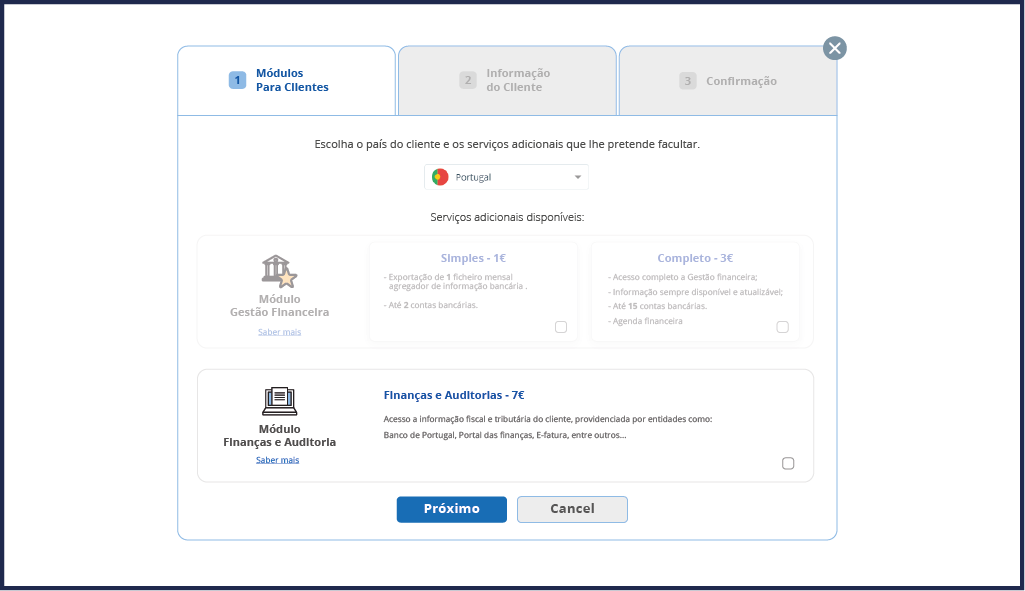
nBanks achieves ISO 27001 certification for Information Security Management. Finance and Audit Additional Modules Discover the Finance and Audit module you can offer to clients you wish to include in your Portfolio. nBanks' additional Finance and Audit services are available to provide to any client you wish to add to your Portfolio. This module works by integrating information from various entities such as E-fatura, Portal das Finanças, Banco de Portugal, among others, and allows you to access the following client information: - New E-Fatura movements; - Credit responsibility map; - Tax responsibility map; - Relevant Social Security data; We remind you that these additional services use the pay-as-you-go system, which only includes billing for these services when your client activates them. Previous Item Next Item
- Quickly update all accounts | nBanks
nBanks achieves ISO 27001 certification for Information Security Management. Quickly update all accounts Learn how to quickly update all bank accounts in nBanks. This Fast Update feature allows you to automatically update the balances of all your bank accounts. Step 1 Access Dashboards , in the upper left corner of the page. Step 2 Click the Fast Update button. Step 3 Wait for all accounts to be updated. And that's it! The balances of all your bank accounts have been updated. Depending on the number of accounts associated with the platform, updating the balances of all accounts may take a few minutes to complete. Previous Item Next Item
- Clear and objective communication with banks is essential for SMEs | nBanks
nBanks achieves ISO 27001 certification for Information Security Management. 13 May 2021 Clear and objective communication with banks is essential for SMEs With a pivotal role in economic and employment development, SMEs face several difficulties. nBanks With a pivotal role in economic and employment development, Small and Medium-sized Enterprises (SMEs) face difficulties in obtaining financing. SMEs are a reality in practically all economic activity sectors in Portugal. “In Portugal, small and medium-sized enterprises are neither listed nor have access to financial markets because, predominantly, a “ bank-based system ” is used, causing them, if they need it, to resort only to banks” for financing, concludes a study conducted for a master's thesis at the University of Minho, carried out in May 2018. The research, authored by Tomás Sardinha, focuses on the difficulty of financing SMEs and seeks to understand how banking institutions differentiate financing conditions between large companies and SMEs. This investigation is based on data from the Bank of Portugal and the National Institute of Statistics (INE) and uses a macroeconomic approach as its methodology (where it analyzes the sector of activity, company size, and market interest rate). The study reveals that, by definition, SMEs usually do not have sufficiently complete accounting organization prepared for the analytical detail that banking institutions apply , which may cause greater obstacles to the financing requested by small and medium-sized enterprises. “There are two types of information that companies can provide: information based on company records (balance sheets, credit history, among others); and another due to the deduction of gaps in accounting information and subject to many errors,” the dissertation states. When a company does not provide sufficient information, it becomes “opaque” and reduces its ability to demonstrate the possible success of the project. Thus, granting credit to companies that present this lack of information becomes a risk for banking institutions, leading them to charge higher interest rates and demand more guarantees. Another reason that, according to the dissertation, underlies the difficulties in financing SMEs is the fact that small banks finance them. In contrast, large banks tend to grant credit to large companies because they believe these obtain better results. On the other hand, small banks will have more similarities with SMEs in terms of organization, which allows for easier approximation and, consequently, fewer reservations when granting credit. The research also shows that “banks prefer to work with more mature companies that have some kind of relationship,” as some companies end up closing in their first year of existence. More mature companies reduce the risk of bankruptcy and become more credible, which conveys security to banks when it comes to financing. There are strong reasons why it is difficult for new companies to obtain financing, because rather than checking whether it is a small, medium, or large company, banking institutions choose to analyze the companies' turnover. “Since they are new [companies], they do not have a credit history or activity history, which makes it more difficult for banks to analyze their projects to grant financing,” analyzes Tomás Sardinha. The study results show that turnover influences by 15% - proportionally more relevant than the other variables - the decision to finance or not a company. When they do not meet the guarantees required by banking institutions, they end up not getting the financing. On the other hand, the results also indicate that SMEs reject these guarantees. Alternatively, small and medium-sized enterprises seek other types of financing, the most common being self-financing - that is, a source of financing generated within the company itself, namely, items such as net income, depreciation, and provisions from the economic year after year -. The dissertation concludes, then, that “for SMEs, whether newly established or not, it seems essential to communicate with banks objectively and clearly, so that financing can be carried out under the best conditions according to the type of company and the investment.” Turnover is also pointed out as the factor that dictates whether the company will be financed or not. Dissertation published in May 2018, authored by Tomás Sardinha, as part of the Master's in Monetary, Banking and Financial Economics, at the University of Minho: http://repositorium.sdum.uminho.pt/handle/1822/55288 Previous Item Next Item
- nBanks recognized by AI² as a suitable entity for Research and Development activities | nBanks
nBanks achieves ISO 27001 certification for Information Security Management. 10 July 2026 nBanks recognized by AI² as a suitable entity for Research and Development activities AI² recognition reinforces nBanks' commitment to advancing innovation through Research and Development in the financial sector. nBanks nBanks (NBKS - Digital Services SA) has been formally recognized as a suitable entity for carrying out Research and Development (R&D) activities by AI² – the Portuguese Agency for Research and Innovation, E.P.E . What this recognition means R&D suitability status confirms that nBanks meets the technical and scientific requirements needed to consistently and credibly carry out research and development activities in its areas of operation, formally reinforcing the innovation work already underway at the company, particularly in Open Banking, Open Finance, and financial data solutions. This recognition is granted by a leading public body within Portugal's science and innovation ecosystem, and marks a significant milestone in nBanks' technological and scientific maturity. A step aligned with nBanks' innovation strategy For nBanks, this recognition reinforces the company's commitment to investing in a structured way in technological innovation applied to the financial sector, strengthening its position as a trusted partner for financial institutions seeking secure, robust solutions grounded in genuine applied research. nBanks will continue to invest in R&D as a core pillar of its strategy, in service of a financial sector that is increasingly digital, open, and data-driven. Previous Item Next Item
- Unified Experience for Counterparties and Transactions | nBanks
nBanks achieves ISO 27001 certification for Information Security Management. 14 May 2026 Unified Experience for Counterparties and Transactions A simpler, faster, and more contextual way to manage counterparties directly within transactions. Managing counterparties in nBanks is now more intuitive than ever. The transaction editing form has been enhanced with a unified experience that removes the need to switch between multiple windows or contexts. You can now manage counterparties directly within the same transaction editing window . Counterparty suggestions are seamlessly integrated into the selector, enabling quick and accurate associations. When needed, new counterparties can also be created without leaving the transaction editing flow, ensuring continuity and focus. This unified experience is reflected across all contexts where counterparties appear: Statement, Portfolio, Inflows/Outflows, and Cards . The transaction editing modal has also been enhanced. Previously limited to editing notes, tags, and counterparties, it is now possible to edit the category directly, making the process more complete within a single interaction. During counterparty association, suggested counterparties are now displayed, allowing users to confirm or reject suggestions directly within the modal. Once a counterparty is confirmed, only the option to remove the association is shown, simplifying the interface. Users can also manually associate a counterparty, edit its details, or remove it, all without leaving the transaction editing context. Finally, multiple counterparty editing is now supported, enabling faster and more efficient data management at scale. Benefits: Unified and smoother editing experience; Edit transaction categories directly in the modal; Manage counterparties without opening additional windows; Integrated smart counterparty suggestions; Create new counterparties without leaving the transaction; Multiple counterparty editing for improved efficiency; Consistent experience across all nBanks modules. Available in all geographies. You can try this feature here . Previous Item Next Item
- More complete exports: new “Debit” and “Credit” columns | nBanks
nBanks achieves ISO 27001 certification for Information Security Management. 26 June 2026 More complete exports: new “Debit” and “Credit” columns Export financial data with greater clarity using the new “Debit” and “Credit” columns, now available for transaction and balance exports. The export functionality has been enhanced with the introduction of two new fields: “ Debit ” and “ Credit ”. These columns can now be added to export configurations and set as default fields in the platform, allowing you to structure exported financial data with a clearer separation between incoming and outgoing movements. With this improvement, exported files can now display transaction values according to their nature: positive transaction amounts are automatically assigned to the “Credit” field, while negative amounts are assigned to the “Debit” field. This makes financial analysis, reconciliation, and integration with external systems more efficient. New available columns Credit: Displays the transaction amount when the value is positive, helping identify incoming funds and credits. Debit: Displays the transaction amount when the value is negative, making it easier to identify outgoing payments and debits. ⚠️ These columns can be configured in the platform’s export settings area and defined as default fields. Benefits: Improve the readability and structure of exported financial data; Easily distinguish between incoming and outgoing transactions; Simplify financial analysis and reconciliation processes; Increase efficiency when exporting account balances and transactions; Facilitate integrations with external systems (ERP); Standardize export formats according to accounting needs. Available for: Bank transaction exports from a specific account; Balance exports across all accounts. Available in all geographies. You can try this feature here . Previous Item Next Item
- Check the Status of your Subscription | nBanks
nBanks achieves ISO 27001 certification for Information Security Management. Check the Status of your Subscription Check the used and available credits in your current Subscription Plan. Step 1 Log in to your nBanks account. Step 2 Access the Personal Settings menu at the top of the page. Step 3 Access the Subscription menu. Step 4 In this area, you can view User Credits and Company Credits. And that's it! You have successfully checked your available credits in nBanks. Previous Item Next Item
- Financial AI for smarter financial operations: know who is behind each transaction | nBanks
nBanks achieves ISO 27001 certification for Information Security Management. Financial AI for smarter financial operations: know who is behind each transaction Financial AI automatically identifies transaction counterparties, adding context to financial data and improving transaction traceability. Bank transactions often contain limited or unclear descriptions. Merchant names may appear abbreviated, payment references can be vague, and identifying the counterparty behind a transaction may require additional investigation. For finance teams managing large numbers of transactions, this lack of context can slow down financial analysis and reconciliation. Financial AI helps solve this challenge by analysing transaction data and identifying counterparties automatically. Adding context to financial data By analysing patterns, transaction descriptions, and historical data, AI systems can recognise merchants, suppliers, and payment recipients. This allows financial records to include clearer and more meaningful transaction information. Improving traceability With better transaction identification, finance teams can more easily understand the origin and purpose of financial movements. This improves financial traceability, reduces uncertainty, and simplifies day-to-day financial monitoring. Next Previous
- Aggregate Bank Accounts | nBanks
nBanks achieves ISO 27001 certification for Information Security Management. Aggregate Bank Accounts Learn how to quickly aggregate your bank accounts in Financial Management. Step 1 Access the Financial Management area. Step 2 Select the Add Bank Account option. Step 3 Select the Country and Institution of the respective bank account. Step 4 On this page, confirm consent to access the information. Step 5 Now, on the Homebanking page of the respective banking institution, enter your access credentials. And that's it! You have just aggregated your first bank account in nBanks. Previous Item Next Item
- Open Banking | nBanks
Open banking platform that connects all your business bank accounts in one place. Automate financial data aggregation, gain real-time visibility, and streamline treasury operations with secure integrations. nBanks achieves ISO 27001 certification for Information Security Management. Open Banking Open Banking provides secure access to your financial data from other institutions, enabling transparency and personalised services. Your bank accounts, all together All your bank accounts in one dashboard, no matter the bank. Always up to date Your financial data updates automatically, in real time. Less manual work Say goodbye to spreadsheets, exports and manual checks. Safe and authorised You decide what data is shared, with full security and control. Beyond Traditional Open Banking Open Banking gives access to bank data. nBanks goes further by transforming that data into powerful financial management tools, enabling businesses to interact with their banking data in smarter and more flexible ways. Fast Account Updates Keep all your financial data up to date. nBanks performs fast updates across all connected bank accounts, ensuring the latest information is always available in the platform. Hourly Exchange Rate Updates Stay aligned with real-time currency movements.Exchange rates are automatically updated every hour, ensuring accurate conversions for international transactions and financial reporting. Unlimited Financial History Access more than the typical 90-day Open Banking limit.nBanks provides access to the full available transaction history, enabling deeper financial analysis and long-term reporting. Inflows & Outflows Access Control Manage who can see what. Control access to financial information by allowing specific users to view only inflows or only outflows within bank statements. Cash Flow Map with Custom Categories Understand how money moves through your business. The cash flow map categorises transactions and allows custom categories, giving a clear view of how funds are entering and leaving the organisation. Financial Dashboards Visualise your financial data clearly.Interactive dashboards provide an overview of balances, transactions, and financial activity across all connected accounts. Interactive & Dynamic Bank Statements Go beyond static bank statements. With nBanks, statements become interactive and dynamic, allowing users to add notes, mark transactions, attach documents, and organise movements using custom tags. Use Cases One Financial View Across Borders: How Open Banking Supports International Businesses For companies operating in multiple countries, Open Banking creates a single, real-time view of bank accounts across markets, simplifying financial management and improving cash visibility. How Open Banking helps high-volume businesses stay in control of daily transactions For businesses processing a large number of daily payments, Open Banking provides real-time visibility over account activity, helping finance teams monitor cash flow and respond faster to operational issues. How Open Banking supports accountants, auditors and portfolio managers Open Banking allows professionals managing multiple clients to access financial data directly and securely, eliminating manual exchanges and ensuring accurate, up-to-date information. See More
- Trends: The Future with Fintechs | nBanks
nBanks achieves ISO 27001 certification for Information Security Management. 26 November 2024 Trends: The Future with Fintechs Discover firsthand how fintechs will shape the future and what trends are in sight. nBanks Discover firsthand how fintechs will shape the future and what trends are on the horizon. Fintechs have revolutionized the banking sector. With the simplification and automation of processes, free from the structures, bureaucracies, and administrative calendars of traditional entities, space opens up for a new paradigm. In this scenario, opportunities multiply. Learn now about some of those that promise to simplify your daily life, and that nBanks will keep in sight. Neobanks This is a digital banking service provider, with the particularity of having no dependence on a physical structure. For this reason, its cost burden is also significantly reduced, as operations, from human resources to logistics, are 100% online. This form of Digital Bank guarantees a more competitive, faster, and lower-cost offer for the consumer, who will be just a click away from performing a routine banking action. Digital financial management platforms - Fintechs They differ from neobanks by not providing banking services, acting as intermediaries between the client and the providers of these products. They are classified as “agnostic” entities, whose mission is to continuously support the client, using Artificial Intelligence to identify the providers that best meet their characteristics and needs. Thus, they are exempt and transparent entities, focused on personalized delivery to the client, as if the client had an accessible analyst and consultant, available 24/7, to help with their treasury and financial management. It is in this sector that nBanks fits, developing a premium Banking as a Service (BaaS) solution. Through this solution, the client can, with simplicity and agility, access their banking data and products. Regardless of their size and complexity or the region they are in, all their bank accounts, from all companies, are centralized on a single screen, with the exchange rate and time window that best serve their needs. The integration of external entities such as the Bank of Portugal, Tax Authority, and Social Security, predictive and risk management analysis, payment integration, and simplified invoicing are also some of the functionalities allowed by the use of technology combined with finance. The future of (digital) payments Recent years have already seen innovations in payment methods, with contactless, blockchain, and interest-free or low-interest payment installments in “Buy Now Pay Later” being examples. In the future, more daring proposals are being discussed, such as the possibility of a Stablecoin's dominance, with stability and transparency, voice or biometric payments, and even AI-driven payments. All these models must be properly regulated. In the Portuguese case, the response is given directly to the Bank of Portugal or the Securities Market Commission (CMVM). The integration of payments into the nBankers' treasury, banking, and finance management platform is one of their most anticipated “dreams”. This project aims to add another functionality to simplify their work routines. The goal with these mechanisms is maximum efficiency with total accessibility and less resource investment. Explore more about BaaS . Security, Regulation, and Compliance The abrupt and revolutionary potential of new technologies, namely Artificial Intelligence, has allowed fintechs to develop innovative products, as is happening in the banking sector. At nBanks, we use it in alignment with current compliance policies, namely through the use of Machine Learning in fraud identification or by integrating the Bank of Portugal. With new opportunities, enhanced personalized deliveries, and the ability to manage sensitive data with agility and ease in intermediate steps, there is also a growing potential for data breach risks, from the simplest to biometric data. Therefore, the need for adequate regulation of these digitalization and virtual data management procedures should not disregard new forms of security, such as IP or Double Token authentication, as well as legislation in sectors such as cybersecurity, data regulation, and fintechs. Ethical AI certifications also complement this point. The EU Artificial Intelligence Act , a pioneering legislative act worldwide, is expected to come into force in the second quarter of 2026. Predictive analysis with AI It is the process through which Artificial Intelligence, based on statistical analysis, identifies patterns, potential behaviors, and future predictions. Due to the large volume of data and complexity of the process, the results offered surpass those humanly possible. With a fast response rate and a high accuracy rate, its value proves to be voluminous and growing, as consumers also turn to personalization, automation, and agility. In the context of banking operations and services, it will be essential not only for the customer experience but also for the analysis and risk management of their operations. The automation of financial decisions, such as investments, is also a key point of this technology. The association of this model with the areas of Open Finance and Open Insurance is also speculated. Will the future reserve a robotized mediator, personalized to your characteristics and needs? The potential of Generative AI in the banking sector Generative AI is a type of artificial intelligence capable of generating content such as images, text, audio, and videos. It starts from data to create the desired final result and, therefore, frames a new aptitude of AI, as it is not restricted to classifying or recognizing patterns, but can now act in the scope of development. This creative functionality can also be leveraged in the banking sector, namely in customer service areas. It is Large Language Models (LLM) and Machine Learning (ML) systems that prove to be truly aggregating in this sector. At nBanks, the latter is already a solid path for process automation, risk analysis, and is expected to be developed in the area of creating predictive analysis and creating financial products. From security to efficiency and personalization, this is the Banking of the future, in digital. Previous Item Next Item
- Recover your nBanks Account Password | nBanks
nBanks achieves ISO 27001 certification for Information Security Management. Recover your nBanks Account Password Find out how to recover your nBanks account password if you've forgotten it. Step 1 Go to the nBanks login page . Step 2 Click on Forgot password? . Step 3 Enter your email associated with the account and click on Send Email . Step 4 Check your email and follow the instructions to create a new password. Previous Item Next Item