Resultados da pesquisa
Search this site
341 results found with an empty search
- GoCardless Now Tells Credit Cards and Accounts Apart | nBanks
nBanks achieves ISO 27001 certification for Information Security Management. 29 July 2026 GoCardless Now Tells Credit Cards and Accounts Apart Credit cards are now identified and processed independently from bank accounts in GoCardless connections. Credit cards are now correctly identified and processed as distinct products within GoCardless. Previously, some institutions delivered accounts and cards through the same data stream, which could cause credit cards to be treated as bank accounts. Now, during both the setup of a new connection and every data refresh, bank accounts and credit cards are handled separately . Credit cards are imported and synchronized using the same card-management architecture already used across the platform, ensuring consistent information throughout. The result is more accurate and complete financial data , especially for institutions that provide both accounts and cards through a single connection, leading to more reliable financial analysis, balance management, and cash flow monitoring. Benefits: Credit cards correctly identified and separated from bank accounts; More accurate and complete financial data from GoCardless; Consistent card management using the platform's existing architecture; More reliable analysis, balance management, and cash flow monitoring. Available in all geographies. Previous Item Next Item
- nBanks at the ARAN Conference to Support Innovation in the Automotive Sector | nBanks
nBanks achieves ISO 27001 certification for Information Security Management. 13 March 2026 nBanks at the ARAN Conference to Support Innovation in the Automotive Sector nBanks present at ARAN to explore how financial technology can support the future of automotive businesses. nBanks Yesterday, 12th March 2026, nBanks was present at the ARAN Conference "Together, Leading the way" , held at the Hilton Porto Gaia. The event brought together companies, entrepreneurs and decision-makers from across the automotive ecosystem to discuss the challenges and opportunities shaping the sector. Organized by the ARAN – Associação Nacional do Ramo Automóvel , the conference provided a platform for dialogue around innovation, business development and the evolution of mobility. With thousands of companies represented across the national automotive industry, ARAN continues to play a key role in strengthening collaboration and progress within the sector. As a sponsor and exhibitor , nBanks participated in the event to connect with automotive businesses and industry partners, sharing insights on how financial technology and Open Banking are transforming the way companies manage financial operations and access financial data. In sectors such as automotive, where operational efficiency, liquidity management and access to reliable financial information are essential, technology is becoming a key enabler of smarter decision-making and business growth. Through its platform, nBanks helps companies aggregate financial information, gain better visibility over their financial position and streamline financial processes. The event was also an opportunity to exchange ideas with professionals from across the industry and explore how collaboration between financial technology and the automotive sector can create new opportunities for innovation. nBanks would like to thank everyone who visited the stand and shared valuable insights during the conference. Initiatives like the ARAN Conference highlight the importance of bringing industries together to build the future of business and mobility. Previous Item Next Item
- The future of organizations: nBanks at Liderteam Summit 2025 | nBanks
nBanks achieves ISO 27001 certification for Information Security Management. 8 April 2025 The future of organizations: nBanks at Liderteam Summit 2025 nBanks participated in the Liderteam Summit 2025 to discuss innovation and the impacts on digital transformation. nBanks nBanks participated in the Liderteam Summit 2025, where business leaders debated innovation, artificial intelligence, sales, and the impact of people on digital transformation. On April 3rd, nBanks was present at the Liderteam Summit 2025 , an event that brought together some of the main business leaders at Porto Business School to discuss the impact of people, processes, and technology on the future of organizations. Organized by Liderteam, the event featured a diverse program, addressing topics such as artificial intelligence, new growth strategies, sales, and the importance of emotional leadership in companies. With the presence of entrepreneurs, business owners, and managers, it was an opportunity to share knowledge and reflect on the challenges of the current market. Among the highlights of the day were Alberto Costa (Liderteam), Joan Carles Colet and Rúben Cunha (Sage), Sofia de Castro Fernandes (blog "Às Nove"), Raquel Soares (Love People), and Cristina Amaro (Brands Community). nBanks believes that technological innovation must go hand in hand with human talent to drive the growth of organizations. At the event, we had the opportunity to exchange ideas about the evolution of the financial sector, the impact of automation, and the importance of business collaboration. It was a privilege for nBanks to be part of this event and reaffirm our commitment to transforming the financial sector with solutions that combine efficiency and proximity. We remain attentive to market changes and ready to lead the future! Previous Item Next Item
- Cashflow Map | nBanks
nBanks achieves ISO 27001 certification for Information Security Management. 2 April 2025 Cashflow Map Monthly Cashflow Map, based on your company's bank statement. Monthly Cashflow Map, based on your company's bank statement. Through the categorization of the bank statement, it is now possible to access the consolidation of the monthly Cashflow. In addition, it is possible to consult, in a macro way, the income and expense items, as well as a mirror of all the company's operational activity, based on the bank transactions of the accounts aggregated in nBanks. Available in all geographies. You can try this feature here . Previous Item Next Item
- Transaction list with visible account identification | nBanks
nBanks achieves ISO 27001 certification for Information Security Management. 18 March 2026 Transaction list with visible account identification The bank and account are now always visible at the top of the list while scrolling. The navigation experience in the transaction list of an account has been improved with a simple but very useful detail for day-to-day use: the header now always displays the associated bank and account, even when scrolling . Until now, when navigating through a long list of transactions, the information about the account and the bank would no longer be visible once the user scrolled down the page. This could create confusion, especially when working with multiple accounts at the same time. With this update, that information remains fixed at the top of the list . Regardless of the number of transactions or the scroll depth, it is always possible to immediately know which bank account the displayed data belongs to. This improvement helps maintain context throughout the navigation, reducing errors and making analysis smoother. Benefits: Immediate identification of the account and bank at any point in the list; Greater clarity when analysing large volumes of transactions; Reduced errors when working with multiple accounts; Simpler and more intuitive navigation. It is a subtle improvement, but one that makes a difference in the daily use of the platform, especially for those managing multiple accounts and needing speed and accuracy when reviewing transactions. This feature is available in all geographies and can be tested here . Previous Item Next Item
- Digital trust: the new pillar of finance services | nBanks
nBanks achieves ISO 27001 certification for Information Security Management. 22 September 2026 Digital trust: the new pillar of finance services In the digital age, trust remains the true currency of banking, now built on cybersecurity rather than physical branches. nBanks Trust has been essential since the dawn of commerce. In the era of direct barter, trust in the quality of the product and the integrity of the merchant was necessary. With the creation of currency, it became even more critical to trust not only the parties involved but also the value of the medium of exchange itself, which led to formal coinage. Later, the increase in transaction volume demanded more efficient representations of capital, giving rise to paper money. With the evolution of the international banking system, fiat currency emerged, requiring even greater trust in the monetary system, since it no longer had direct and full convertibility into gold reserves. It is within this context of progressive dematerialization that the digital age has emerged, where services are increasingly disconnected from physical reality and linked to the virtual sphere, bringing with them a natural sense of mistrust. Today, when all services are available on the internet, trust is even more imperative than in the past. Trust is required in the quality of products and services, in the reliability of merchants, and in the stability of the financial system itself. We must be certain that money deposited in the bank is safeguarded; we must prevent and avoid online scams; and it is also essential to trust that large technology platforms like Google handle data ethically and securely. Thus, digital trust has become the cornerstone of modern financial services . Security no longer depends on safes, keys, or paper signatures, but rather on the strength of encryption, protection against cyberattacks, and the transparency of institutions. The global and nearly instantaneous mobility of capital is only possible thanks to this invisible foundation. Without this sense of security, the digital financial ecosystem itself collapses, as trust is the true currency that enables the continuity of transactions in the modern era . The importance of this factor is clear in consumer behavior. According to the Marktest Basef Banca study (covering the four-month period ending in May 2011), the attribute "being trustworthy" was cited by Portuguese consumers as the most important aspect of a bank, receiving the preference of 21.7% of residents in mainland Portugal aged 15 or older. Clarity of information (21.1%) and quality of customer service (20.6%) followed closely behind. Other factors, such as financial stability (7.8%), loan interest rates (6.7%), efficiency (4.2%), and deposit interest rates (3.3%), recorded significantly lower percentages. A historical analysis of this data reveals a significant structural shift: the quality of in-person customer service, which had been the clear leader since 2002, began to lose ground starting in 2007 and was overtaken in 2009. The expansion of digital channels, with online banking and digital banking at the forefront, largely explains the reduced importance placed on human interaction at the teller window. In contrast, perceptions of "trust" and "clear information" have skyrocketed. The year 2008 marked a decisive turning point in public opinion , in a clear reaction to the instability and loss of credibility caused by the global financial crisis of that period. In recent decades, this phenomenon has not only taken hold but has also intensified exponentially. The transition to a fully digital environment, accelerated by the democratization of Artificial Intelligence (AI) and the emergence of concepts such as Open Banking, has brought new challenges. While AI enables the personalization of services and real-time fraud detection, it also exposes users to more sophisticated threats, such as hyper-realistic phishing, deepfakes, and automated social engineering . In short, the history of commerce shows that the means of exchange are changing, but the need for trust remains unchanged. In the digital age, trust is no longer built on the physical grandeur of a bank branch, but rather on the efficient invisibility of cybersecurity and the ethics of data handling. In a world dominated by algorithms and artificial intelligence, the challenge for the financial services industry is to ensure that technological innovation never outpaces user security. After all, technology may be the engine of modern banking, but trust will continue to be, as it always has been, its fuel . Previous Item Next Item
- Access and Account Vault | nBanks
nBanks achieves ISO 27001 certification for Information Security Management. 2 April 2025 Access and Account Vault Management of accesses and reorganization of the access vault. Access management and reorganization of the access vault. With these updates, access and account management has become simpler and more intuitive for our clients: Simplified Access and Account Management: - Easily associate each account with the corresponding company; - Save all configurations at the end of the process; - In addition, you can add, rename, and delete accesses. Reorganization of the Access Vault: - Listing of all accesses by banking institution; - Accounts associated with a selected access; - Accounts organized by section: Current Accounts, Collateralized Accounts, etc. Available in all geographies. You can try this feature here . Previous Item Next Item
- New features in Global Position | nBanks
nBanks achieves ISO 27001 certification for Information Security Management. 25 March 2025 New features in Global Position Integration of new features in Global Position. Integration of new features in Global Position. Improvements have been introduced in integrations in Portugal: - Banco de Portugal: sector tables - Banco de Portugal: account database - Portal das Finanças: supporting documents in IUCs Available in the following geographies: Portugal. You can try this feature here . Previous Item Next Item
- Account Status Filter: A cleaner, more focused Accounts page | nBanks
nBanks achieves ISO 27001 certification for Information Security Management. 25 August 2026 Account Status Filter: A cleaner, more focused Accounts page Show only what matters by filtering accounts by their current state, right alongside search. Organizations that manage a large number of bank accounts now have a faster way to navigate them. A new Account Status filter has been added to the Accounts page, letting accounts be displayed according to their current state so the view stays focused on what's relevant. The filter sits in the action bar next to the search field and offers three options: All , showing every account; Active , showing only active accounts; and Inactive , showing accounts that have been deactivated. By default, the page now opens with Active selected, so only active accounts appear when you access the screen. An account is considered inactive once it has been deactivated through the Account Configurations area using the Close/Deactivate Account option. The new filter also works hand in hand with existing search, letting accounts be narrowed by status and text criteria simultaneously for quicker, more precise results. The result is an Accounts page that feels cleaner and more focused , particularly for organizations that accumulate a large number of accounts over time. By prioritizing active accounts and keeping inactive ones just a click away, navigation becomes more efficient, helping users find and manage the information that matters most. Benefits: Filter accounts by Active, Inactive, or All; Active accounts shown by default for a cleaner page; Combined status and text search for faster navigation; Quick access to inactive accounts when needed; Ideal for organizations managing large volumes of accounts. Available in all geographies. You can try this feature here . Previous Item Next Item
- nBanks eligible for the new “Artificial Intelligence in SMEs” Measure | nBanks
nBanks achieves ISO 27001 certification for Information Security Management. 8 October 2025 nBanks eligible for the new “Artificial Intelligence in SMEs” Measure nBanks eligible for the “AI in SMEs” measure of the PRR, supporting companies in adopting AI solutions. nBanks The new Investment Incentive C05-i14.01: “Business Innovation” Notice 03/C05-i14.01/2025 - “AI in SMEs” Line , integrated into the Recovery and Resilience Plan (PRR) , is now available for applications. This initiative aims to support Portuguese micro, small, and medium-sized enterprises in adopting Artificial Intelligence (AI)-based solutions, promoting productivity, efficiency, and the digital transformation of the Portuguese business fabric. The nBanks platform is eligible under this measure, as it incorporates various AI-supported functionalities, such as: - Automatic categorization of bank transactions; - Intelligent identification of counterparties; - Automation of transforming banking data into Budget and Forecast. These functionalities practically translate the objectives of the measure: improve efficiency, automate processes, and promote innovation through the use of intelligent technologies. nBanks clients can use this information as technical justification in their applications, demonstrating how the platform contributes to the digitalization and optimization of financial management. It is important to emphasize that the preparation and submission of the application, as well as confirmation of eligibility, rests entirely with the proposing entity , which may do so with the help of a specialized consultant. nBanks does not intervene in the application process or in the evaluation of eligibility. For more information, it is recommended to consult Ordinance No. 286/2025/1, of August 14 , of the Official Gazette regarding the "Financial Instrument for Innovation and Competitiveness" (IFIC) Incentive. nBanks is available for any clarification regarding its inclusion in this measure via email: commercial@nbanks.net Previous Item Next Item
- Silence Is the Proof of Reliability: When Nothing Happens, Something Is Working | nBanks
nBanks achieves ISO 27001 certification for Information Security Management. 27 October 2026 Silence Is the Proof of Reliability: When Nothing Happens, Something Is Working In company finance, the best infrastructure goes unnoticed: no failed syncs, unexplained entries or month-end surprises. That silence reflects systems built, tested and monitored to perform reliably. Daniel Silva On a good morning, a treasurer opens one screen and the overnight movements from every bank are already there. Balances agree with the statements and there is no email from IT about a failed connection. Nobody remarks on a morning like that, which is the point. In September 1991, Mark Weiser of Xerox PARC opened an article in Scientific American with this line: " The most profound technologies are those that disappear. They weave themselves into the fabric of everyday life until they are indistinguishable from it." Further on, he gave the reason: "Whenever people learn something sufficiently well, they cease to be aware of it. " Disappearing is not the same as being absent. In 1995, Weiser and John Seely Brown wrote " Designing Calm Technology ", using driving as one example. At the wheel, our attention is on the road and not on the engine, yet "an unusual noise is noticed immediately". A calm technology, they wrote, " will move easily from the periphery of our attention, to the center, and back. " That is a fair standard for finance systems. The quiet only has value if something underneath is still listening, so the one failed sync or unrecognised payment comes forward at once, while everything else stays out of the way. Failure is loud. In April 2018, TSB, a UK retail bank, migrated the data for its corporate and customer services onto a new IT platform. According to the Financial Conduct Authority, "the data itself migrated successfully", but the platform "immediately experienced technical failures". All of TSB's branches and a significant proportion of its 5.2 million customers were affected, and business as usual did not return until December 2018 . In December 2022, the FCA and the Prudential Regulation Authority fined TSB £48.65 million. The data was never the problem. The layer that carried it was, and once it broke, it took eight months to make it quiet again. Breakdowns like this are becoming less frequent, but not cheaper. Uptime Institute's Annual Outage Analysis 2026 reports that, for a fifth consecutive year, outage frequency per site is declining. Yet in Uptime's 2025 survey, 57% of respondents said their most recent major outage cost more than US$100,000 , and for the second year running one in five reported costs above US$1 million. Third-party IT and data centre providers have accounted for about two-thirds of the public outages Uptime has tracked over nine years. In July 2024, a single faulty CrowdStrike update affected an estimated 8.5 million Windows devices, according to Microsoft. Regulators no longer leave that quiet to chance. The EU's Digital Operational Resilience Act (DORA) entered into application on 17 January 2025. The European Insurance and Occupational Pensions Authority describes its aim as ensuring that banks, insurers, investment firms and other financial entities " can withstand, respond to, and recover from " ICT disruptions. It applies to 20 types of financial entities and to ICT third-party service providers. A finance team does not need to be regulated to borrow the logic: any provider between a company and its banks should be able to say where the data lives, how recovery is tested, who watches at night and where clients can check that all is well. Those questions are a fair way to read nBanks , the Porto and Lisbon company whose platform connects businesses to 5,000+ banks across 75+ countries. Its security page opens with "Secure by design. Safe by default." and adds: "Security isn't a feature we added, it's the foundation we built on." Of its three principles, confidentiality, integrity and availability, the third gets one plain sentence: "EU-hosted cloud with geographically distributed backups and tested recovery keeps you running." Data is encrypted in transit and at rest, and "Everything stays within the EU." Access follows a Zero Trust model, " Never trust, Always verify ", and a security operations centre runs 24/7 because "Threats don't keep office hours, and neither do we." nBanks also states that it is compliant with PSD2, the Payment Services Directive , and links a public status page from its website, so the quiet can be checked rather than assumed. Pedro Sá, financial manager at Mota-Engil Africa, says nBanks gives the company central control and real-time access to 285 bank accounts held across 33 operations in 16 countries. On most days, none of that should be visible. If the treasurer opens one screen and finds nothing to chase, the infrastructure underneath has done its job, and the silence is the evidence. Sources The Computer for the 21st Century (Mark Weiser, September 1991), Scientific American, https://www.scientificamerican.com/article/the-computer-for-the-21st-century/ The Computer for the 21st Century (full text), CalmTech, https://calmtech.com/papers/computer-for-the-21st-century.html Designing Calm Technology (Mark Weiser and John Seely Brown, Xerox PARC, 1995), CalmTech, https://calmtech.com/papers/designing-calm-technology.html TSB fined £48.65m for operational resilience failings, Financial Conduct Authority, https://www.fca.org.uk/news/press-releases/tsb-fined-48m-operational-resilience-failings Uptime Announces Annual Outage Analysis Report 2026, Uptime Institute, https://uptimeinstitute.com/about-ui/press-releases/uptime-announces-annual-outage-analysis-report-2026 Helping our customers through the CrowdStrike outage, Official Microsoft Blog, https://blogs.microsoft.com/blog/2024/07/20/helping-our-customers-through-the-crowdstrike-outage/ Digital Operational Resilience Act (DORA), European Insurance and Occupational Pensions Authority, https://www.eiopa.europa.eu/digital-operational-resilience-act-dora_en nBanks | Financial Management Software, nBanks, https://www.nbanks.net/en Security | nBanks, nBanks, https://www.nbanks.net/en/security nBanks Status, nBanks, https://nbanks.statuspage.io/ Previous Item Next Item
- New Global Settings options for counterparty management | nBanks
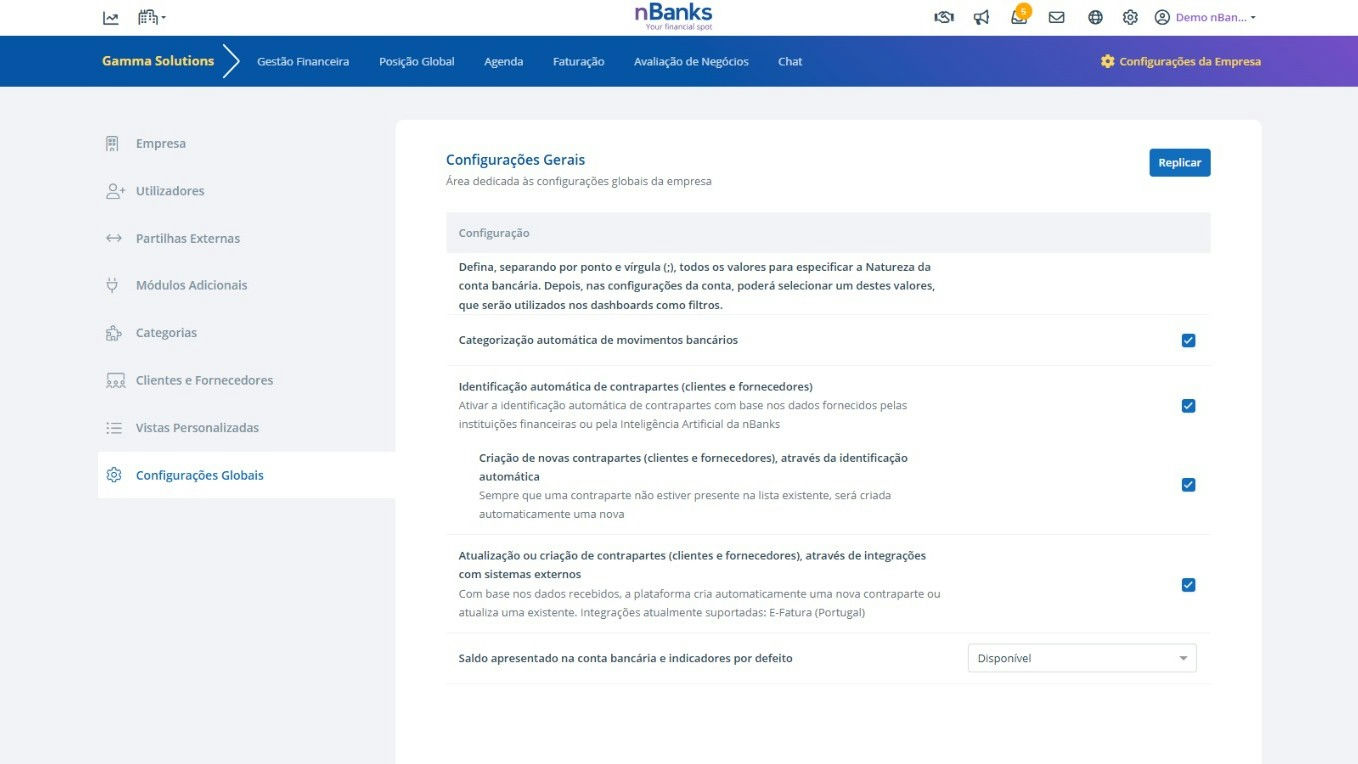
nBanks achieves ISO 27001 certification for Information Security Management. 24 September 2025 New Global Settings options for counterparty management New Global Settings with options for automatic counterparty identification and creation via AI. nBanks now offers new Global Settings options, allowing users to define how they want to manage the identification and creation of counterparties (customers and suppliers) through Artificial Intelligence and external integrations. Until now, users could manually import a list of counterparties via Excel file or API. With these new settings, they gain greater flexibility and automation in the process. 1. Automatic identification of counterparties (customers and suppliers) When this option is enabled, nBanks' Artificial Intelligence automatically identifies the counterparties associated with each bank transaction, based on information provided by the banks. 2. Creation of new counterparties (customers and suppliers), through automatic identification In addition to identification, users can choose to allow nBanks' Artificial Intelligence to create new counterparties whenever they are not present in the existing list of customers and suppliers. 3. Updating or creation of counterparties (customers and suppliers), through integrations with external systems Another available option is the possibility to update or create counterparties based on external integrations, such as E-Fatura. This way, the system ensures that the information remains consistent and up-to-date. Benefits: - Greater flexibility in counterparty management; - Automation of the process of identifying and creating new counterparties; - Reduction of manual work and associated errors; - Seamless integration with external systems like E-Fatura; - Improvement in the quality and reliability of financial data; - Greater user control, by being able to activate or deactivate these options according to their preference. Available in all geographies. You can try this feature here . Previous Item Next Item