Resultados da pesquisa
Search this site
341 results found with an empty search
- Renewal of Consent for Access to Bank Accounts | nBanks
nBanks achieves ISO 27001 certification for Information Security Management. Renewal of Consent for Access to Bank Accounts Learn how to renew consent to access your bank accounts to update their balances and transactions again. Step 1 Access the Financial Management feature. Step 2 Select the banking institution that displays the following signage. Step 3 Subsequently, you should identify the marked account and click on its notification. Step 4 Now, in the Pending Validations area, click on Reactivate to continue the process. And that's it! The nBanks system will update your consent in a few seconds and resume automatic information updates. nBanks will regain access to banking data for another 180 days. This process must be repeated whenever consent expires. If there are past periods where consent was not renewed, nBanks will not be able to retrieve data from that time period. Previous Item Next Item
- Category Customization | nBanks
nBanks achieves ISO 27001 certification for Information Security Management. 2 April 2025 Category Customization Ability to create and customize categories. Ability to create and customize categories. Now, it is possible to create your own categories and, with these, more effectively categorize your company's bank movements. Our Machine Learning system, after some time, starts to automatically categorize movements taking into account your categories. All of these are also used in the Cashflow functionality. In addition, in category management, you can do the following: - Create, edit, and delete categories; - Define an icon and a color; - Select the type: revenue, expense, or neutral; - Replicate categories to other companies. Available in all geographies. You can try this feature here . Previous Item Next Item
- The relevance of Open Banking in Africa | nBanks
nBanks achieves ISO 27001 certification for Information Security Management. 8 February 2023 The relevance of Open Banking in Africa nBanks CEO, Orlando Costa, explains what makes Africa an attractive market for Open Banking. nBanks With the consolidation of nBanks' presence in Africa, the question arises: what makes this continent an attractive market for the implementation of open banking solutions? Orlando Costa, the CEO of the Portuguese fintech - the first to arrive in African territory with this type of services - brings us the answers. Discover them in this article. “As a rule, it is quite common for each African country to have a considerable number of banks operating locally, and it is also a frequent practice for companies to work directly with several of these banks,” explains the manager. Orlando Costa's statement clarifies, at the same time, Africa's attractiveness for the use of Open Banking and the concrete gains that these solutions bring. Given the work of African companies with a multiplicity of banking entities, Open Banking supports the managers of these entities in “streamlining payment processes, gathering useful information for better decision-making, or creating better negotiation conditions,” he exemplifies. These gains become more obvious if we consider that, in addition to the diversity of banks and, consequently, accounts, African countries face “differentiated currencies and daily exchange rate fluctuations that require great rigor in daily liquidity management,” emphasizes the CEO, also highlighting the “fragilities of technological infrastructure in various banking entities,” as well as the dependence on rigid data structures of these institutions. The good news is that the benefits achieved fuel new advantages, in a true snowball with positive effects for banks and companies in all sectors. The attraction of more and better investments for the African market deserves to be highlighted. Open Banking, Orlando emphasizes, “is a tool that promotes efficiency, agility, strengthens financial literacy and, by inherent, incentives for companies to feel attracted to invest locally from the moment they can use management tools that reduce logistical and linguistic barriers.” With Open Banking being formally introduced in other regions of the world, such as Latin America, it is Africa's turn to take this step with the support of nBanks. The conditions are favorable. The gains promise to be even greater. Previous Item Next Item
- RendiValor powered by nBanks – the best bet | nBanks
nBanks achieves ISO 27001 certification for Information Security Management. 18 November 2023 RendiValor powered by nBanks – the best bet Discovering the best interest rates for your home loan can be easy with RendiValor's simulator nBanks When it comes to discovering the best interest rates for your home loan, the process can be simplified with the help of the home loan simulator provided free of charge by Rendivalor powered by nBanks. Through this resource, it is possible to carry out a single simulation that will allow you to calculate the desired home loan amount and compare offers from all banks in Portugal. Through Rendivalor powered by nBanks, you also have the opportunity to directly apply for the most advantageous home loan, benefiting from an online approval process that eliminates the need for in-person visits to bank branches. This results in a faster and less bureaucratic approval process, with the support of our specialized team. Using our home loan simulator is efficient and straightforward. Simply select the desired financing amount, the desired term, and the property value. After the home loan simulation, you will have access to a detailed results table that will allow you to compare various real estate loan proposals. Important factors such as the APRC, the Total Amount Payable by the Consumer, the spread, and the monthly installment will be highlighted so that you can make an informed decision. Through our home loan simulator, you will have a comprehensive view of all these elements, which will help you make a clear decision about the best loan solution for your home. After the risk assessment by the banking institutions, the home loan application will be approved or not. In case of approval, you will receive a detailed document with the conditions offered by each bank, known as FINE. Thus, with the help of Rendivalor powered by nBanks, finding the most advantageous home loan becomes a simple and effective task. Previous Item Next Item
- The digital revolution in the banking sector and the financial literacy of Portuguese people | nBanks
nBanks achieves ISO 27001 certification for Information Security Management. 5 April 2025 The digital revolution in the banking sector and the financial literacy of Portuguese people Interview with Orlando Gomes da Costa, CEO of nBanks nBanks Orlando Gomes da Costa holds a degree in Management from the University of Minho. He began his professional career at Banco Português de Investimento (BPI) as a Key Account Manager. He remained at BPI for over 15 years, accumulating various positions: Investment Advisor; Investment & Sales Dynamization Adviser; Head of Procurement Management – Investment; and Head of Procurement Management – Corporate Center. In 2018, together with Ricardo Vieira and Nuno Oliveira, he decided to create nBanks, a financial management software with aggregated, qualified, and independent information, integrating services such as Open Banking, Software as a Service (SaaS), and Banking as a Service (BaaS). Since March 2019, he has been the CEO of nBanks. During his more than 20 years of professional career, he also held some roles outside the financial world, such as: Vice President of Grupo Desportivo de Chaves and responsible for communication and marketing (2011-2014); and Economy Editor at “Sinal TV,” a weekly television program (2013-2014). Since 2022, he has also served as a visiting professor at the Polytechnic Institute of Cávado and Ave (IPCA). Outside the financial world, who is Orlando Costa? What are his personal tastes and what activities bring him the most happiness? I can admit that I am an ordinary person like many others… passionate about art and culture, I find inspiration and constant learning in reading and cinema. Travel also holds a special place in my life, as I value discovering new cultures and experiences that help broaden my horizons. Furthermore, I value the balance between professional and personal life. I find great happiness in activities that connect me to nature, such as hiking and outdoor moments, and I value time with family and friends, which bring lightness and authenticity to my daily life. This dedication to personal well-being is reflected in my view that success is not only measured by financial results, but also by the ability to cultivate meaningful relationships and enjoy life's small pleasures. Beyond this, and perhaps as more particular tastes, I love driving, both on the road and on the track, with karts or other vehicles. I love driving simulators. I love conversations in the style of tertúlias. Philosophizing. Participating in podcasts. Reading inspiring biographies, such as Winston Churchill's. Or Steve Jobs'. Anyway. But nothing inspires me more than talking and learning to see the world through my daughter's eyes. Learning every day and at the same time living as if it were the last! Your professional journey began in the banking sector and evolved into entrepreneurship. What led you to take this leap and create nBanks? The creation of nBanks arose from the need to modernize how companies manage their finances, leveraging Open Banking. After years in the banking sector, it became evident that there was a gap in the market for a solution that aggregated and simplified the management of multiple bank accounts and financial data, allowing companies to make more informed and strategic decisions. What differentiates nBanks from other financial solutions on the market? nBanks stands out for its innovative approach to corporate financial management, integrating Open Banking, Software as a Service (SaaS), and Banking as a Service (BaaS) to offer a complete ecosystem of financial services. Instead of just being a bank aggregator, it enables process automation, efficient bank reconciliation, and other real-time financial information, helping companies optimize their time and resources. Customer acquisition costs are a challenge for all fintechs. How does nBanks manage to scale its business without relying on massive marketing investments? nBanks' strategy focuses on strategic partnerships and offering real value to customers. Through integrations with software and ERPs, we can reach companies that need our solutions. Furthermore, recommendations from satisfied customers have been an important lever for organic growth, as has the help of our partners. Internally, we created the world's first team of Open Banking & Financial AI Advisors, responsible for monitoring the sector's evolution, as well as acquiring new clients, contributing to the development of trusting relationships and the creation of sustainable value. With the growing development of digital financial solutions, how do you see the role of “traditional banking” in this trend in Portugal? Is its disappearance a likely scenario, or will this be an opportunity for banking to reinvent itself and invest in new strategies? Traditional banking faces a great challenge, but also a huge opportunity for adaptation. Digitalization and Open Banking force banks to reinvent themselves, offering more agile and personalized services that respond to customer needs. The trend does not point to the disappearance of traditional banking, but rather to a scenario of greater collaboration with fintechs, where banks become more technological and focused on customer experience. They will act as intermediaries and not owners of information. Portugal has been attracting more and more tech startups. Is the regulatory and financial environment already favorable for the growth of fintechs like nBanks? Portugal has made progress, but there is still a long way to go. The country has a good startup ecosystem, good talent, and interesting tax incentives, but bureaucracy and the response time of regulatory bodies are still challenges. For companies like fintechs, dealing with legislation can be complicated, especially when compared to more agile markets. Still, initiatives like Fintech House, Portugal FinLab, and innovation hubs show that there is an effort to make the environment more favorable. If Portugal continues to simplify processes and create better conditions to attract investment, it can become a true attraction for fintechs in Europe. Portuguese people traditionally invest mainly in savings certificates, which do not even allow them to cover inflation and lead to a loss of wealth. What products can Portuguese people invest in to have a financial cushion for their retirement, especially at a time when we live with great concern regarding the future of Social Security? I believe that diversification is key to sustainable investment. In addition to savings certificates, Portuguese people should consider other investments that make sense for their financial situation. There is a wide variety of investment products, including: ETFs, Retirement Savings Plans (PPRs), bonds, stocks, or even alternatives such as real estate. I would say that financial literacy is essential for each person to find the best strategy for their profile. John C. Bogle, founder of Vanguard, was a fierce critic of investing in actively managed funds, stating that the overwhelming majority of these funds are not even able to reach their benchmark. Currently, the global economy is based on a financial system that includes hundreds of actively managed funds with trillions of Assets Under Management. Do you agree with Bogle's position? Do you believe that the products offered by these funds are of poor quality and consciously deceive investors? Bogle argued that most actively managed funds fail to outperform the market in the long run and that their high costs ultimately harm investors. In many cases, this is true, but there are also actively managed funds that perform well and are justifiable for certain investor profiles. Ultimately, it's not about saying that one product is better than another or that one approach is better than another, but rather understanding that each strategy has its place. Each investment decision should be adapted to the goals, timeframe, and risk tolerance of each person. Personally, I feel that the most important thing is for investors to have access to clear information to choose the strategy or product that makes the most sense for them. With the existence of Prop Firms, amateur trading is a financial activity with more and more fans. However, the approaches that have existed involve the assumption that there is market manipulation. Do you believe that markets are effectively manipulated by algorithms and Big Players, in search of liquidity from retail traders? The financial market can be influenced by algorithms and institutions, but that doesn't mean it's manipulation in the illegal sense. Large institutions use advanced technology to find opportunities and manage risk, which can create a challenging environment for amateur traders. Still, regulatory transparency has evolved to minimize unfair practices, but investors should be aware of the risks. More and more financial decisions are being made by algorithms and artificial intelligence. Do you think technology can completely replace human analysis in credit granting and risk management? Technology and artificial intelligence are powerful tools to make financial decisions faster, more accurate, and more informed. But it's important to remember that they should be a means, not an end. AI can help analyze data, identify patterns, and reduce errors, but there are factors that go beyond numbers – such as context, ethics, and the real impact of a decision. I usually think that the ideal is to use technology as a source for better insights and to support the choices we make, but the final decision should remain human. After all, there are things that an algorithm simply cannot interpret like a human. You can read this interview in full here . Previous Item Next Item
- Open Banking: State of the Art | nBanks
nBanks achieves ISO 27001 certification for Information Security Management. 30 June 2026 Open Banking: State of the Art Open banking is evolving into a global financial ecosystem, driven by regulation, data sharing, AI, and the shift towards open finance and embedded services. Daniel Silva What It Is and Where It Comes From Open banking starts from a straightforward idea: a customer's financial data belongs to the customer, not the bank. With their consent, that data can be shared with third parties through secure APIs, allowing other companies to offer more competitive financial services. What began as a European regulatory push with PSD2 in 2018 has grown into a global phenomenon, with distinct models taking shape across Europe, the UK, Brazil, India, and the United States. What the Research Shows The academic literature on open banking is young but already producing concrete findings. Babina et al. (2025) show, using UK data, that third-party access to customer data lowered barriers for fintechs to enter the market and expanded the range of services available to consumers. On the credit side, open banking reduced financing costs for small businesses and increased their likelihood of accessing non-bank lenders, though the effects on financial inclusion have been more limited than initially expected (Babina et al., 2024). Colangelo and Khandelwal (2025) draw a useful distinction between mandate-driven models, where regulators require banks to open their APIs, and market-driven models, where everything depends on bilateral deals between banks and fintechs. The first tends to produce more consistency and consumer protection; the second offers more flexibility but also more fragmentation. The Cambridge Centre for Alternative Finance (CCAF, 2024) reports that 60 jurisdictions have now implemented some form of open banking rules, with fostering competition in financial services standing as the leading goal in 44 of them. In terms of maturity, the UK leads the pack: in 2025 it recorded 24 billion API calls and 351 million open banking payments, with API availability above 99.5% throughout the year (Open Banking Limited, 2026). Brazil and India stand out in emerging markets, with Pix and UPI together processing hundreds of billions of transactions annually, proving that it is possible to leapfrog legacy infrastructure when the system is designed from scratch. Australia illustrates the adoption challenge: despite a solid regulatory framework, only 0.31% of bank customers had an active data-sharing arrangement in 2024, and 51% of agreements that were set up were eventually revoked (Lux, 2025). Regulation creates the conditions, but it does not guarantee adoption. The most active research frontier right now is the convergence with artificial intelligence: open banking data feeds machine learning models for fraud detection, alternative credit scoring, and personalized financial services, but autonomous AI agents capable of executing financial transactions raise liability and governance questions that current regulatory frameworks have yet to answer (Nayak, 2026). PSD3, PSR, and FIDA: The New European Framework The EU is finalizing a sweeping overhaul of its payments regulatory framework. In November 2025, the European Parliament and the Council reached a provisional political agreement on the Third Payment Services Directive (PSD3) and a new Payment Services Regulation (PSR); the final texts were published on April 23, 2026, with entry into force expected in 2027 after a 21-month transition period. The most fundamental change is architectural: where PSD2 was a directive that generated national divergences, the PSR applies directly and uniformly across all EU member states, eliminating the regulatory arbitrage that developed under the previous regime. For open banking specifically, API obligations become more granular, with mandatory performance parity, consent dashboards for consumers, and the AISP authorization cycle extended from 180 to 365 days. On fraud, the PSR generalizes IBAN and payee name verification to all credit transfers and introduces clear liability for APP fraud cases in which a fraudster manipulates the user into authorizing a payment. Running in parallel, the Financial Data Access Regulation (FIDA), still in trilogue as of April 2026, goes further by extending data-sharing obligations to pensions, insurance, and investments, with full operationalization expected around 2029-2030. EY (2026) reports that European banking executives consider the impact of FIDA to be greater than that of PSD3/PSR combined. Future Trends and the Impact on Bank Business Models Open banking is increasingly viewed as the first step towards open finance and the era of embedded finance, where payments, credit, and insurance are built directly into non-financial platforms. The global value of open banking transactions is projected to grow from $57 billion in 2023 to $330 billion in 2027, an increase of over 500%. Account-to-account payments are gaining share from cards, compressing interchange revenues for banks, a pressure that the McKinsey Global Payments Report (2025) documents in detail. For incumbent banks, the disintermediation risk is real but not inevitable. The Mastercard Payments Trends Navigator (February 2026) is direct in its assessment: the shift from proprietary platforms to open ecosystems is the next operating model for banking. Banks that limit themselves to exposing compliance APIs risk becoming invisible infrastructure. Those that act strategically have four paths available: becoming aggregation platforms for third-party services, supplying licensed banking infrastructure to fintechs through Banking-as-a-Service, specializing in niches where proprietary data creates a defensible advantage, or pursuing consolidation, a rational move in a context where the technology budgets of the largest banks exceed those of regional banks by more than tenfold. Mastercard's research with Financial Times Longitude (2026) finds that 75% of executives report direct revenue uplift from open finance initiatives, and the Mastercard/Harris Poll survey (2025) reveals that 93% of businesses expect industry momentum to increase over the next five years. Trust emerges as the decisive strategic variable: incumbent banks start with an advantage, as 66% of consumers trust banks to share their financial data, but they can lose that advantage if their digital experience falls short of what fintechs deliver. The McKinsey Global Banking Annual Review (2026) documents a growing bifurcation between banks that have shifted toward fee-based services and those that remain anchored to the balance sheet, a divergence that is showing up in market valuations. The convergence of open banking, artificial intelligence, and embedded finance is not a trend to monitor from a distance, but the next operating model of the financial industry. References Babina, T. et al. (2024). Customer data access and fintech entry: Early evidence from open banking. NBER Working Paper No. 32089. Babina, T. et al. (2025). Customer data access and fintech entry. Journal of Financial Economics, 169. CCAF (2024). The Global State of Open Banking and Open Finance. Cambridge Centre for Alternative Finance, Cambridge Judge Business School. CEPR (2025). The impact of fintech on lending. VoxEU. Colangelo, G. & Khandelwal, P. (2025). The many shades of open banking. Internet Policy Review, 14(1). EY (2026). What banks need to know to prepare for the impacts of the FiDA regulation. Ernst & Young Global. Freshfields (2026). PSD3/PSR: What the EU's new payments rules mean for your business. Lux, M. (2025). Open banking: Lessons, challenges, and opportunities. Georgetown Fintech Policy. Mastercard & Harris Poll (2025). Building trust in the age of open banking. Mastercard & FT Longitude (2026). The state of open finance 2026. Mastercard Business Intelligence (2026). Payments Trends Navigator, February 2026. McKinsey & Company (2025). Global Payments Report 2025. McKinsey & Company (2026). Global Banking Annual Review 2026. Nayak, S. K. (2026). New era of finance: The impact of AI on open banking. SSRN. Open Banking Limited (2026). Open banking in 2025: Now part of the UK's everyday financial life. Xie, C. & Hu, S. (2024). Open banking: An early review. Journal of Internet and Digital Economics, 4(2), 73-82. Previous Item Next Item
- Additional Modules Financial Management | nBanks
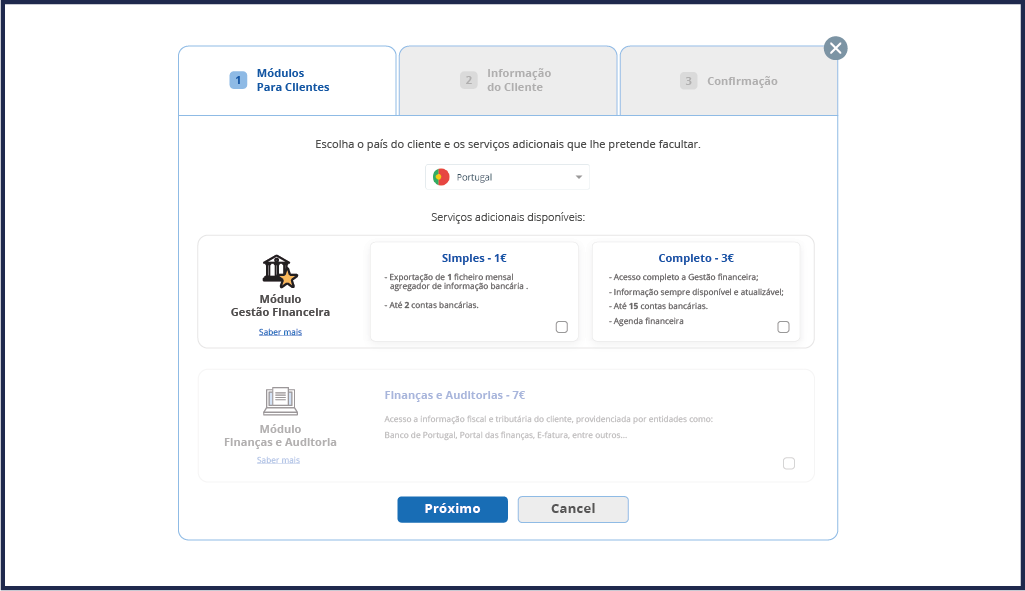
nBanks achieves ISO 27001 certification for Information Security Management. Additional Modules Financial Management Discover the Financial Management modules you can offer to clients you want to include in your Portfolio. nBanks' additional Financial Management services are divided into two modules that you can provide at any time to clients you want to add to your Portfolio. The first is Simple Financial Management, which includes the following features: - Aggregation of up to 2 bank accounts; - Access to a monthly aggregated file of your client's banking information; Or the Complete Financial Management module, which includes: - Aggregation of up to 10 bank accounts; - Private chat with the client for sharing messages and documents; - Access to the client's Financial Agenda; - Banking history always available and updatable; - Access to all Financial Management features that allow you to consult client information, namely: Dynamic and interactive statement, Personalized accounts, Management Dashboards, File export, among other relevant tools. We remind you that these additional services use the pay-as-you-go system, which only includes billing for these services when your client activates them. Previous Item Next Item
- nBanks in a major interview in País Económico magazine | nBanks
nBanks achieves ISO 27001 certification for Information Security Management. 9 September 2021 nBanks in a major interview in País Económico magazine País Económico magazine conducted a major interview with nBanks CEO Orlando Gomes Costa. João Ferrão The September issue of País Económico magazine features a major interview by Jorge Alegria with nBanks CEO Orlando Gomes Costa, in which he answers questions such as the reasons for the company's creation, the services it provides to its clients, the added value of nBanks services for the activity of client companies, among other relevant questions. Read the full interview in País Económico magazine now at: https://bit.ly/EntrevistaPaisEconomiconBanks Previous Item Next Item
- nBanks brings Financial AI to associations | nBanks
nBanks achieves ISO 27001 certification for Information Security Management. 29 November 2024 nBanks brings Financial AI to associations Moments of knowledge sharing, networking, and promotion of financial literacy mark the team's agenda. nBanks Moments of knowledge sharing, networking and promotion of financial literacy mark the team's agenda. The last fortnight at nBanks was filled with moments of knowledge sharing, networking and promotion of financial literacy. Its different teams once again approached the market. Namely in the youth association movement, also close to Academia, where the country's next managers and financiers are found, it made clear that it is interested not only in the present, but also in the future of the sector. It got to know the challenges of each area up close and was instrumental in demystifying Artificial Intelligence and its applications to the treasury and financial management of organizations, from the simplest to the most complex. Get a first-hand look at one of these moments: Nov 16 - 🗣️ 20th ENAJ National Meeting of Youth Associations 🚀 The 20th ENAJ - National Meeting of Youth Associations took place from November 15 to 17, in Covilhã. It brought together more than 600 participants from all over the country, including the Autonomous Regions, in a meeting on the theme of Artificial Intelligence. It was in one of these moments of sharing and reflection, in a “privileged space to celebrate the strength of youth associations and promote dialogue on essential topics for the future of youth” that nBanks acted. Carina Seabra, on behalf of nBanks , was invited to share the stage with Paulo Dimas, Vice-president of Innovation at Unbabel and CEO of the Center for Responsible AI and Pedro Marcelino, founder of TreeTree2 - Scientific Learning in Portugal . Under the moderation of Helder Tavares, radio announcer at Cidade FM , she demystified the use of Artificial Intelligence in the treasury management of organizations, framing the topic in the project @vança! - Business Mobilization Program to Combat Financial Illiteracy . Thus, the first action with young people took place. The program has other models of partnership plans . According to the team at FNAJ - National Federation of Youth Associations , “the collaboration was fundamental for the success of this event, enriching discussions and strengthening the foundations for fairer policies and initiatives aligned with the needs of young people”. They also complement that the “valuable intervention on The Application and Challenges of Artificial Intelligence brought a unique and extremely relevant perspective, which certainly captured the attention of all present”. Alongside illustrious figures from the world of technology and Artificial Intelligence, nBanks stimulated a differentiating, “in-depth and captivating approach to the implications of artificial intelligence in the most diverse areas of everyday life and the difference it can make in people's lives and associative work, (which) broadened the horizons of young people, stimulating critical reflection on the impact of these technologies on the future of society and the active role that young people can play in this transformative scenario”. Previous Item Next Item
- How Open Banking helps high-volume businesses stay in control of daily transactions | nBanks
nBanks achieves ISO 27001 certification for Information Security Management. How Open Banking helps high-volume businesses stay in control of daily transactions For businesses processing a large number of daily payments, Open Banking provides real-time visibility over account activity, helping finance teams monitor cash flow and respond faster to operational issues. Businesses that process a high volume of transactions every day depend on constant financial visibility. Incoming payments, supplier transfers, operational expenses, and internal movements can add up to hundreds or even thousands of daily transactions. In sectors such as retail, hospitality, transportation, and wholesale distribution , this level of activity is part of normal operations. However, monitoring all these movements across multiple bank accounts can quickly become a demanding task. Many finance teams still rely on manual checks to keep track of account activity. Logging into several banking platforms, downloading statements, or manually reviewing transaction lists can consume valuable time and delay the identification of potential issues. Open Banking introduces a more efficient way to manage this complexity. Real-time monitoring of account activity With Open Banking, bank accounts can be connected to a single platform where balances and transactions are automatically updated in real time. This means finance teams no longer need to constantly access multiple banking portals. Instead, they gain a continuous overview of all financial activity across their accounts. For businesses with high transaction volumes, this level of visibility allows teams to monitor cash inflows and outflows throughout the day. Unusual transactions, missing payments, or unexpected account movements can be identified much faster. Better operational control Real-time visibility also improves operational control. For example, a retail chain can track daily revenue from different store locations as payments arrive. A transport company can monitor supplier payments and operational expenses across several regional accounts. A hospitality group can keep track of income from multiple venues without manually reviewing each bank account. By removing the need for constant manual checks, Open Banking helps finance teams stay focused on higher-value financial management tasks. For businesses that operate at high transaction volumes, this level of control becomes essential for maintaining operational efficiency and financial oversight. Next Previous
- nBanks Benefits | nBanks
Discover how companies achieve real results with our financial software. Improve visibility, automate financial operations, and unlock measurable ROI with corporate financial management solutions. nBanks achieves ISO 27001 certification for Information Security Management. Real results with nBanks Companies face different setups, but the challenges are often the same: Too many accounts Disconnected systems Time lost on manual work This page walks through three real-world scenarios, showing the starting point, how nBanks fits into daily operations, and the measurable results achieved. Open Banking: Centralized Visibility Across Global Accounts The Challenge: A multinational company operating across 4 continents manages over 100 bank accounts across different institutions. Financial data is fragmented, requiring manual extraction from multiple banking portals and consolidation in Excel. There is no real-time visibility, and over 50% of the finance team’s effort is spent just gathering data. Value Delivered: Centralization of all bank accounts into a single platform Automatic data aggregation from multiple banks Real-time balance and transaction visibility Elimination of manual data collection and Excel consolidation Standardized data structure across all entities 1000 Hours Saved per Year €45K Estimated Annual Savings 55% Cost Reduction 600% ROI 3-6 Payback (months) Open Finance: End-to-End Process Automation The Challenge: A mid-to-large enterprise handles high transaction volumes across multiple entities. Financial processes such as reconciliation, payments, and reporting are manual, slow, and error-prone. Reporting is fragmented and often outdated, limiting operational efficiency and increasing risk. Value Delivered: Automated bank reconciliation processes End-to-end financial workflow automation Integration between banking data and internal financial systems Real-time reporting and dashboards Reduction of manual intervention in repetitive tasks 1500 Hours Saved per Year €30K Estimated Annual Savings 35% Cost Reduction 400% ROI 4-7 Payback (months) AI Agents: Intelligent Financial Analysis and Decision-Making The Challenge: Finance teams spend most of their time on operational work, leaving little room for analysis and strategic decision-making. Even when data is available, extracting insights requires manual effort, limiting the CFO’s ability to act quickly and confidently. Value Delivered: AI-driven financial analysis and anomaly detection Automated insights generation from real-time data Decision-support tools for forecasting and performance tracking Intelligent alerts and recommendations Continuous learning from financial patterns and behaviors 3500 Hours Saved per Year €80K Estimated Annual Savings 60% Cost Reduction 800% ROI 2-5 Payback (months) See What This Looks Like for You Book a call with our Advisors and discover how nBanks can streamline your financial operations. Book a Call
- Global Coverage | nBanks
Global banking integration platform connecting financial data across 90+ countries. Explore supported banks, search by country, and access real-time financial connections in one place. nBanks achieves ISO 27001 certification for Information Security Management. Missing an integration? Tell us what you need. Every connection is built and maintained in-house by our team — so if it's not on the list yet, we'll connect it for you, quickly and securely. Request an integration