Resultados da pesquisa
Search this site
341 results found with an empty search
- New banking entities added | nBanks
nBanks achieves ISO 27001 certification for Information Security Management. 16 October 2025 New banking entities added 7 new banks available on the platform. The following banks are now available on the platform: - Allied Irish Bank Corporate (Ireland) - BMCE – Bank of Africa (Morocco) - Garanti BBVA (Turkey) - Yapi Kredi (Turkey) - IDC Internacional Trading DMCC (United Arab Emirates) - Santander Nexus (England) - TPA - Vinti4 da S/SP (Cape Verde) Available in the following geographies: Ireland, Morocco, Turkey, United Arab Emirates, England and Cape Verde . You can consult all available banks here . Previous Item Next Item
- ERP's Integration | nBanks
Integrate real-time banking data into your ERP to automate financial processes, centralize accounts, and gain accurate, structured insights across all entities. nBanks achieves ISO 27001 certification for Information Security Management. Fast, agile and intuitive bank reconciliation, directly in your ERP Empower your ERP with real-time banking data to automate reconciliation and financial operations. Faster processes, fewer errors, and a better user experience. Discover nBanks’ integration modules for businesses, ready to be integrated into ERPs Cegid Primavera A business management solution widely used in Portugal, helping to control finances, invoicing, purchasing, sales, and human resources in an integrated way. Cegid PHC Perform bank reconciliation for your business easily, quickly, and intuitively in the Cegid PHC environment. Sage X3 A robust ERP for growing companies that centralizes financial operations, logistics, and production in a single system. SAP S/4HANA A modern SAP ERP platform that enables managing the entire company in real time, with faster and more intelligent processes. SAP Fiori A simple and intuitive SAP interface that makes it easier to access applications and improves the user experience. SAP Business Technology Platform A cloud platform that connects systems, data, and applications, enabling the creation of solutions and the automation of business processes. SAP ECC A traditional SAP ERP system still used by many companies to manage finances, logistics, and operations. Microsoft Dynamics 365 Business Central Microsoft’s cloud ERP for small and medium-sized enterprises, integrating finances, sales, purchasing, and operations in a single system. Campfire ERP An AI-native ERP built for high-growth tech companies and multi-entity SaaS businesses, automating complex revenue recognition and financial consolidation in a modern general ledger. LightClient ERP A lightweight, web-based ERP interface designed to provide remote, fast, and secure access to core business management functions without the need for heavy local installations. NetSuite ERP A highly scalable, cloud-based ERP suite by Oracle that integrates financial management, CRM, e-commerce, and inventory control for mid-sized to enterprise-level businesses. Odoo ERP An open-source, highly customizable, and modular ERP platform that allows growing companies to easily integrate sales, CRM, inventory, accounting, and project management. Rillet ERP An AI-powered accounting and ERP platform purpose-built for SaaS and startup companies, streamlining complex ASC 606 revenue recognition and automating financial closes. TocOnline ERP A widely-used Portuguese cloud-based management and accounting platform that connects businesses and accountants with integrated invoicing, salary, and tax compliance tools. Workday ERP An enterprise-grade, cloud-based platform that unifies financial management, planning, and human capital management (HCM) for large-scale organizations. SolidSoft GC A cloud-based condominium management platform that streamlines accounting, treasury, maintenance, and resident communication, automating administrative tasks and improving operational efficiency. Everything your ERP needs, in one integration Bring real-time banking data directly into your ERP with nBanks and automate financial processes with accurate, structured and up-to-date information. User-linked company portfolios in one place Aggregated bank accounts across all entities Real-time balances and transaction feeds Enriched transaction data, including notes and categories Your Questions, Answered If I'm already an nBanks customer, what do I have to do to benefit from this integration with my ERP? It's simple, just buy the module you want by ordering it through the Marketplace. If I'm not an nBanks customer, what do I have to do to benefit from this integration with my ERP? It's simple, just buy the nBanks plan and the module you want when you place the order through the Marketplace. How long does the integration module take? The integration module lasts for a year and is associated with the nBanks plan, so both will have to be renewed annually to continue to benefit from the integrated information. What is the price of the integration module? The price of each of these modules varies depending on the ERP in question and the type of nBanks plan subscribed to. You can ask the respective nBanks partner associated with the ERP you have selected to consult the prices. Who sells the integration modules available on the nBanks Marketplace? The integration modules are marketed by nBanks partners duly identified in the Marketplace, with nBanks being responsible for the interconnection between the module subscriber and the respective partner. To have the nBanks information updated and integrated into my software, do I need to have an nBanks plan at the same time? Yes, in order for the information to be constantly integrated and updated in your ERP, the nBanks plan and the module must be active. Is it possible to subscribe to a module for my personalized nBanks plan? Yes, an integration module is available for all nBanks customers, including those with a Custom plan. It just depends on whether your ERP/Software is available in the nBanks Marketplace. If this is not the case, you can contact us to see if it's possible to integrate with another software/ERP.
- Financing Management: new area allows controlling all credits received by a company in one place | nBanks
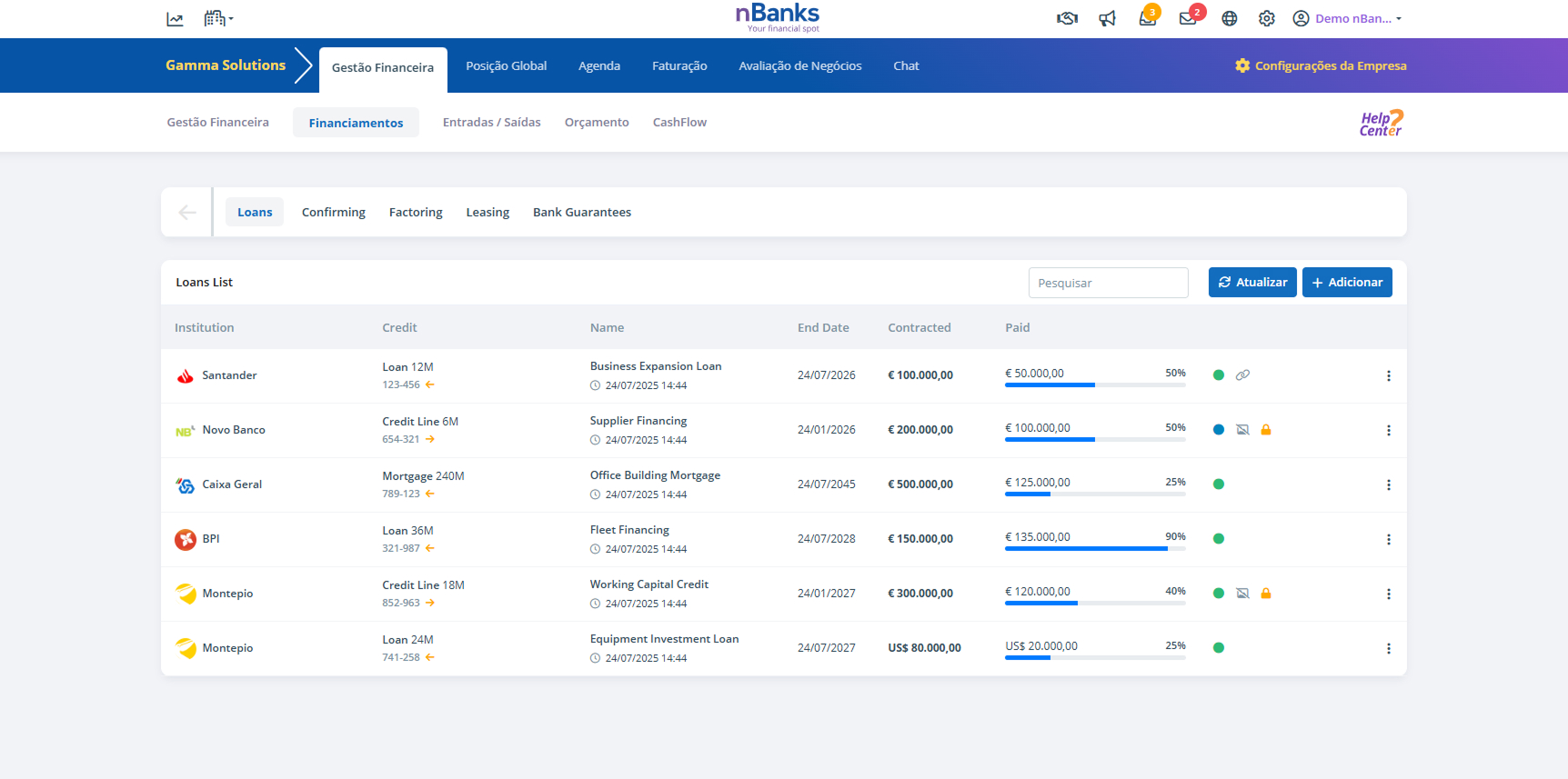
nBanks achieves ISO 27001 certification for Information Security Management. 16 October 2025 Financing Management: new area allows controlling all credits received by a company in one place New Financing Area with management and control of loans. nBanks has just launched a new feature in the Treasury area: Financing. This new section allows you to view and monitor all active financing in a centralized and organized way. The new Financing area is available in the Treasury section, within which you will find the Loans tab. This tab was designed to meet the specific financial management needs of companies, with fields adapted to each type of financing and a clear visualization of the most relevant information. Loans: total control over the company's credits In the Loans tab, it is possible to consult a detailed list of credits received, between companies. The list presents information such as the name of the financing, institution, type of credit, end date, total contracted amount, amount already paid, amount due, and status. The Financing area was designed to ensure total control, centralization of information, and ease in making financial decisions. The evolution of payments can be monitored in real-time, allowing companies to quickly identify which financing is closest to total amortization and which requires more attention. To make the process even simpler and more efficient, the Financing area now allows : - Adding a bank account directly from the Loans tab, through an accelerator button, avoiding the need to previously access the Banks tab; - Automatically associating a loan from a bank account previously linked in nBanks; - Automatically associating a payment plan, with continuous data updates; - Displaying the payment plan, allowing monitoring the status of each installment and the amortization history; - Listing all active loans in a consolidated manner; - Searching for specific loans, facilitating navigation and quick access to desired information. The functionality is available upon activation of the additional module, ensuring greater flexibility and adaptation to the needs of each user. Benefits: - Consolidation of the company's financing in one place; - Simplified monitoring of payment progress; - More rigorous control over deadlines and financial obligations; - Facilitates the analysis and planning of new credits; - Optimizes the decision-making process in the company's financial management. Available in all geographies. You can see this update in the new platform navigation menu, here . Previous Item Next Item
- The Money Came In. But Who Paid? | nBanks
nBanks achieves ISO 27001 certification for Information Security Management. 3 November 2026 The Money Came In. But Who Paid? A credit on the bank statement proves that money arrived. It does not always say who sent it, which customer it belongs to or which invoices it settles. Duarte Bouças Picture a Tuesday morning in a mid-sized distribution company. A credit transfer for a few thousand euros appears on the bank statement. The description holds a reference code nobody recognises, and the name next to it is not on the customer list. It is the fourth credit that week still waiting to be confirmed. Someone in accounts searches the shared inbox for a remittance advice. Someone else filters the open invoices by amount, hoping one of them matches. Then a message arrives from sales: the customer says they paid on Friday, so can the next order go out? The money is in the account. Nobody can yet say whose it is. Receiving money and understanding a receipt are two separate events, and the bank statement only records the first. The rest depends on what the payer chose to type. In a SEPA credit transfer, the free-text remittance field holds up to 140 characters. The European Payments Council , which manages the SEPA schemes, says this field enables the beneficiary to reconcile payments with receivables automatically. It is also optional. Some payers write the invoice number, others leave the field blank, and the company receiving the money has to work out the rest. The name on the transfer adds a second doubt. Under the SEPA rules, the payer's name should be the name of the account holder being debited, and that may not be the name the team knows. A customer may trade under a brand and pay from the account of its legal entity. An owner may pay from a personal account, or a parent company may settle invoices for its subsidiaries. SEPA has an optional field for these cases, called " Ultimate Debtor " in the payment message, for the person or company on whose behalf the payment is made. When the payer leaves it empty, the only name the payment carries for the payer is the account holder's. It helps to keep three questions apart, because they tend to get merged. The first is who sent the money, meaning the account holder on the transfer. The second is which customer or commercial relationship the payment belongs to, which may be another company in the same group. The third is which document, or documents, the payment settles. One transfer can pay four invoices at once and deduct a credit note. Knowing the sender answers the first question. It does not answer the other two, and treating it as if it did can lead to receipts being allocated to the wrong invoice. A receipt nobody can place does not stay a single task. Until someone identifies it, the customer's account still shows the invoice as overdue, and the ageing report shows a debt that has in fact been paid. The credit controller may send a reminder to a customer who has already paid, and sales may hold an order for a client who is up to date. Each step is small. Together they become a run of emails, calls and spreadsheet searches, and they reach the customer just after the customer did what was asked. Volume makes this a routine problem. In 2024, SICOI, the Portuguese interbank clearing system, processed 223 million SEPA credit transfers worth €443.8 billion , according to Banco de Portugal. Each of them carried whatever description the payer chose to write, or none at all. A company that receives hundreds of transfers a month needs only a small share of unclear ones to keep someone busy. Each unclear entry waits until someone finds the email or the phone call that explains it. Identifying the counterparty changes where the work starts. In nBanks, global settings let each company decide how its customers and suppliers are identified and created as counterparties. With automatic identification switched on, the nBanks AI works out which counterparty is behind each bank transaction, using the information the banks provide. The aim is to detect and standardise counterparties, so that payers and beneficiaries can be recognised across the company's financial activity. Companies can also let the AI create a counterparty that is not yet on their list, or update the list through integrations such as E-Fatura, the Portuguese tax authority's invoice portal. Identification has limits. Knowing the payer is not the same as categorising the movement or reconciling it with invoices, and on the nBanks platform these are separate functions. Identification works from the information the banks provide, so when the description is empty and the account holder is unknown, the decision still belongs to a person. In nBanks, that person can comment directly on the bank transaction and mention colleagues, and the company's accountant can join the conversation. The answer then stays attached to the movement instead of going back and forth by email. The AI handles the cases the bank data can settle, and the team keeps its attention for the ones that need judgement. Go back to that Tuesday morning. The money arrived early, and the balance did not change after that. What changed, hours or days later, was that someone could say who paid, on behalf of which customer, and for which invoices. Until that moment the company had a value on its statement. Afterwards it had a receipt it understood, and a customer it could stop chasing. Sources https://www.europeanpaymentscouncil.eu/sites/default/files/kb/file/2024-11/EPC125-05%202025%20SCT%20Rulebook%20version%201.0.pdf https://www.europeanpaymentscouncil.eu/sites/default/files/kb/file/2025-10/EPC132-08%20SCT%20C2PSP%20IG%202025%20V1.0.pdf https://www.bportugal.pt/sites/default/files/documents/2025-05/rsp2024.pdf Previous Item Next Item
- Bank Transaction Receipt gets a Redesigned Layout with Company Branding | nBanks
nBanks achieves ISO 27001 certification for Information Security Management. 15 July 2026 Bank Transaction Receipt gets a Redesigned Layout with Company Branding A more polished, professional document with clearer structure and company branding. The Bank Transaction Receipt document has been updated , bringing improvements to both the presentation of information and the visual customization of the document. The new version introduces changes across the header, body, and footer of the receipt, and can be exported from the usual location: Transaction Line Options > "Export to PDF" . In the header, the company's logo is now displayed whenever available, with the nBanks logo shown as a fallback when no company logo is set. The document title has also been updated to " Bank Transaction Receipt ", replacing the previous "Movement Date" title, making the purpose of the document immediately clear. The body of the document has been reorganized, with existing fields restructured to provide a simpler and more logical reading flow. The footer now includes nBanks identification along with the date and time the document was created , adding an extra layer of traceability. With this update, the Bank Transaction Receipt offers a more personalized and professional appearance, reinforcing each company's visual identity through the use of its own logo. The improved organization of information also makes the document clearer, more structured, and easier to read and interpret. Benefits: - Company logo displayed in the header for a personalized look; - Automatic fallback to the nBanks logo when no company logo is set; - Clearer, more accurate document title; - Reorganized fields for easier, more structured reading; - Footer includes nBanks identification plus creation date and time; - More professional, branded, and informative document overall. Available in all geographies. Previous Item Next Item
- nBanks at FEP: Connecting Education and Financial Innovation | nBanks
nBanks achieves ISO 27001 certification for Information Security Management. 24 February 2025 nBanks at FEP: Connecting Education and Financial Innovation nBanks promotes masterclass on the importance of integrating Open Banking with Financial AI. nBanks nBanks promotes masterclass on the importance of integrating Open Banking with Financial AI. Last January, nBanks was present at the Executive Master's in Banking, Financial Instruments and Markets, at the Faculty of Economics of Porto (FEP), strengthening its connection to the sector and contributing to the debate on financial innovation. The masterclass, led by nBanks CEO, Orlando Gomes Costa, provided moments of knowledge sharing, networking and discussion on financial literacy, Open Banking, Open Finance and AI. Together with specialists such as Carla Rodrigues da Mãe and João Teles (CMVM) and Nuno Alves (Millennium BCP), topics such as the challenges of the sector and the financial and regulatory reality were addressed. nBanks was present at another event of its institutional partner, FEP, reinforcing the importance of integrating Open Banking with Financial AI to overcome the challenges of the sector. The initiative contributed to the promotion of knowledge and financial literacy among students. Previous Item Next Item
- Redesigned Transaction Editing Modal | nBanks
nBanks achieves ISO 27001 certification for Information Security Management. 15 July 2026 Redesigned Transaction Editing Modal A cleaner, more modern design that makes managing transaction details faster and more intuitive. The transaction editing modal has received a complete visual and functional overhaul, bringing it in line with a more modern design language while making everyday transaction management simpler and more intuitive. The new layout organizes transaction information more clearly , making it easier to review and update details such as notes, categories, tags, and counterparties at a glance. Fields are better structured and visually distinct, reducing friction when editing and helping users find exactly what they need without unnecessary clicks or scrolling. Beyond the visual redesign, one of the key additions is native attachment management. Users can now attach, view, and delete files directly within the modal , without ever needing to leave it. This means receipts, invoices, or supporting documents can be added and reviewed in the same place where the rest of the transaction is edited, keeping all relevant information centralized in a single, consistent workflow. Together, these improvements make transaction editing feel less like a technical task and more like a streamlined part of daily financial management, reducing the number of steps and windows needed to keep records accurate and complete. Benefits: - Modern, cleaner modal design for a more intuitive experience; - Clearer organization of transaction fields for faster edits; - Attach, view, and delete files directly within the modal; - No need to leave the modal to manage supporting documents; - All transaction-related information centralized in one place; - Faster, more efficient transaction management overall. Available in all geographies. You can try this feature here . Previous Item Next Item
- Category and Subcategory Management | nBanks
nBanks achieves ISO 27001 certification for Information Security Management. 2 April 2025 Category and Subcategory Management Possibility to customize categories and subcategories. Possibility to customize categories and subcategories. In addition to customizing categories, the creation and customization of subcategories is now also available. Objectives: - Allow users to customize and create categories and subcategories to optimize financial management on the platform; - Enable users to have more personalized and efficient financial management, adapted to the specific needs of the company; - Comprehensive view, allowing macro-level analysis when viewing categories. Benefits: - Detailed Budget: Allows the creation of detailed budget items based on customized categories; - Cash-flow Map: Facilitates analysis, providing a clear and organized view by category and subcategory and the impact on operational cash flow; - Automatic Categorization: A process that is initially manual, through machine learning and continuous categorization of banking history, categorization becomes automatic. This simplifies and reduces the time spent by employees on routine tasks and frees them up for other higher value-added tasks; - Simplified Financial Management: nBanks provides companies with tools for simplified reading of financial data and support for superior decision-making, with personalized detail and precision adapted to the needs of each company. Available in all geographies. You can try this feature here . Previous Item Next Item
- Revolut fees now visible in sub-transactions | nBanks
nBanks achieves ISO 27001 certification for Information Security Management. 18 March 2026 Revolut fees now visible in sub-transactions Fees associated with Revolut transactions are now automatically recorded in sub-transactions. Revolut account management in nBanks has become more complete. Fees associated with each transaction are now visible and recorded directly within the sub-transactions of each movement. Until now, these costs might not have been fully reflected in detail on the platform, making it harder to accurately analyse banking charges. With this update, each fee charged by Revolut is now automatically linked to its respective transaction, integrated as a sub-transaction. In practice, this means there is no longer a need to manually calculate or record these values . The information is centralised and organised, allowing for a clearer understanding of the real impact of each transaction. This improvement is especially relevant for companies that frequently use Revolut and need to closely monitor the costs associated with their financial operations. Benefits: Greater transparency over banking fees; Automatic recording of costs associated with each transaction; Improved control and monitoring of expenses; More accurate and comprehensive financial analysis. With this update, nBanks reinforces visibility over all components of each transaction, helping ensure more detailed and reliable financial control for Revolut users . This feature is available in all geographies and can be tested here . Previous Item Next Item
- Permission Management for Bank Account Updates | nBanks
nBanks achieves ISO 27001 certification for Information Security Management. 3 April 2025 Permission Management for Bank Account Updates Segregation of permissions for different users in updating Bank Accounts. Segregation of permissions for different users when updating Bank Accounts. From now on, nBanks allows segregating permissions so that only some users of a company can update Bank Accounts. Benefits: The main benefit of this permission segregation feature is to ensure greater security and control over the updating of Bank Accounts within the platform. By allowing only authorized users to perform this action, the company: - Avoids unauthorized or accidental access to sensitive functionalities; - Reduces the risk of operational errors, by limiting intervention only to users with assigned knowledge and responsibility; - Gains more control over financial data shared via Open Banking; - Facilitates internal permission management, adapting the use of the platform to the hierarchy and functions of employees. Available in all geographies. You can try this feature here . Previous Item Next Item
- nBanks in Bulgaria: a cross-border value proposition. | nBanks
nBanks achieves ISO 27001 certification for Information Security Management. 27 September 2019 nBanks in Bulgaria: a cross-border value proposition. With the prospect of expanding nBanks' business model to Central Europe, CEO and CFO Orlando Gomes Rita Mata dos Santos With the prospect of expanding nBanks' business model to Central Europe, CEO and CFO Orlando Gomes Costa and Nuno Oliveira, respectively, held a series of meetings last week with institutions and stakeholders in Bulgaria, one of them with the Bulgarian-Portuguese Chamber of Commerce, represented by its Vice-President Dr. Stanimir Mihaylov (pictured, center). Bulgaria currently represents a rapidly growing economy and has an ongoing application to join the single currency. From the due diligence and contacts, strategic steps emerged for nBanks' presence in this country to become a reality soon, serving local companies and accountants. What else might be interesting to know about Bulgaria? Learn about some indicators and curiosities about this country: Its GDP grew 3.2% in 2018, having already grown 3.5% in 2017; Its active population represents a significant weight in its demographic pyramid, thus presenting an inverted model compared to the most developed countries in the European Union; Its tax policy is quite attractive for foreign investment, currently practicing income tax rates that can reach 10%, for individuals or businesses. Thus, large multinational corporate groups are already setting up manufacturing or service units in this country; Although some technological “gap” is expected compared to other more Western countries, we note that there are already highly evolved financial payment services today; Bulgarian citizens with degrees in Engineering are highly sought after by various companies today, being known for their natural aptitude for mathematics and discipline. They are also quite creative, and Bulgaria is also credited with the invention of the car airbag and the digital clock; Although it does not yet apply the single currency Euro, its local currency (Lev) is indexed to the Euro, currently standing at €0.51 per Lev. In addition to exchange rate stability, it is now expected that joining the single currency can further boost the growth of this emerging economy; There are currently 15 Credit Institutions in Bulgaria, making it a competitive market in terms of banking competition; Many Portuguese people are already working in this country, particularly in the area of technological services. Previous Item Next Item
- Financial AI: Interacting with financial data in a simpler way | nBanks
nBanks achieves ISO 27001 certification for Information Security Management. Financial AI: Interacting with financial data in a simpler way Financial AI allows teams to ask questions about their financial data in natural language and receive clear insights without complex analysis. Accessing financial insights often requires navigating reports, analysing spreadsheets, or running queries within financial software. While these tools are powerful, they can also create barriers for teams that need quick answers without spending time on manual data analysis. Financial AI introduces a more intuitive way to interact with financial information. Natural language financial queries Instead of searching through dashboards or exporting reports, users can simply ask questions about their financial data. For example, a finance manager might ask about recent spending trends, large transactions during the past month, or unusual account activity. The AI interprets the data and generates clear answers or reports based on the request. Faster access to financial insights This conversational approach makes financial information easier to access across the organisation. Teams can obtain insights more quickly, enabling faster decision-making and improving overall financial awareness. Next Previous