Resultados da pesquisa
Search this site
341 results found with an empty search
- Payer Identification 2.0 Update | nBanks
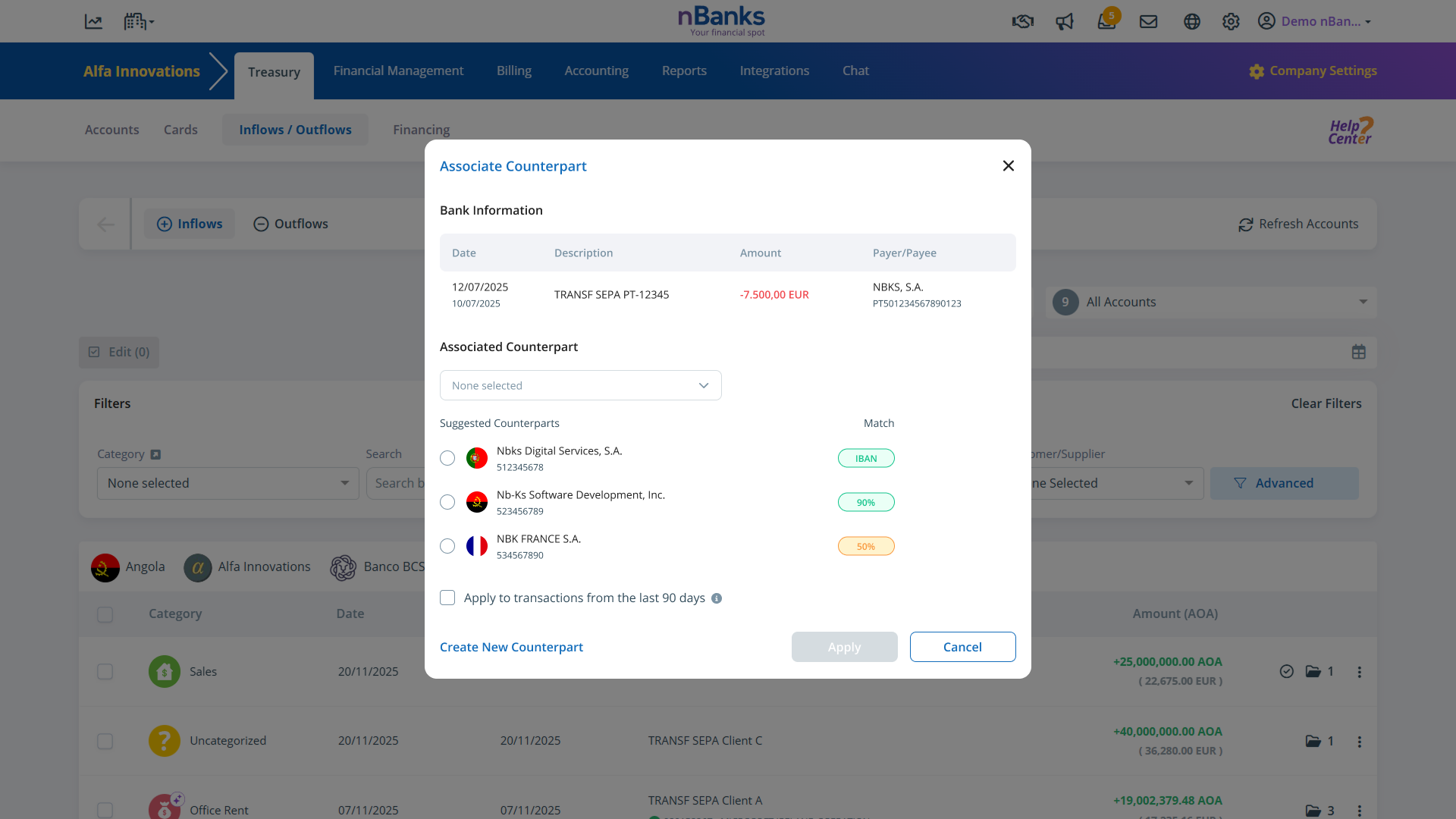
nBanks achieves ISO 27001 certification for Information Security Management. 22 January 2026 Payer Identification 2.0 Update Improvements in payer identification and management, making associations faster and more automatic. With the Payer Identification 2.0 feature update, nBanks reinforces automation and usability in counterparty management , addressing common scenarios such as old movements, incomplete data, or the need for quick adjustments. The main novelty is the retroactive association by IBAN , which allows identifying counterparties in existing movements, even after the initial import. This means less manual work and greater historical data consistency. When the IBAN is not available, the new automatic association by description comes into play, significantly speeding up the identification process based on the information present in the movements. To give users more control, a Counterparty Settings module has also been added, centralizing rules and preferences, as well as a direct shortcut for editing counterparties , reducing steps and making data adjustment faster and more intuitive. What changes in practice? This update reduces the time spent on identifying payers, improves data quality, and makes the process more fluid, even in contexts with a large volume of movements or incomplete information. Benefits: - Retroactive association of counterparties by IBAN; - New Counterparty Settings module; - Automatic association of counterparties by description; - Possibility to add imported files to the import area; - Direct shortcut to access counterparty editing. This feature is available in all geographies . You can try this feature here . Previous Item Next Item
- Bankruptcy prediction: an analysis of prediction models for Portuguese SMEs | nBanks
nBanks achieves ISO 27001 certification for Information Security Management. 30 August 2019 Bankruptcy prediction: an analysis of prediction models for Portuguese SMEs For the benefit of its clients, nBanks invests in an important source of knowledge and innovation: research. Rita Mata dos Santos For the benefit of its clients, nBanks invests in an important source of knowledge and innovation: academic research. As part of its partnership with the University of Minho, we interviewed Mara Almeida, author of a master's thesis that defines a predictive model to help Portuguese companies at risk of default or bankruptcy. nBanks - Tell us a little about yourself and your background. Mara Almeida - My name is Mara Almeida, I am 23 years old and I am Cape Verdean. I lived in Cape Verde until I was 18, when I finished 12th grade and headed to Portugal to continue my studies. I entered the University of Minho, where I graduated in Economics and, currently, I am pursuing a master's degree in Finance at the same University. It has been a long journey full of learning. nBanks - What motivated you to collaborate with nBanks? M.A. - When I started my master's degree in Finance, I wasn't sure what topic I would like to develop for my thesis and I hoped that, throughout the first year, it would become clearer. During this period, I had the opportunity to develop a thesis proposal for a course called Research Methods, which aimed to offer preparation for the second year of the master's degree and in which I addressed the topic of corporate bankruptcy. By researching this topic, I began to gain interest in it. When it came to choosing thesis topics and projects, the Finance master's board presented some reference topics, among which were projects that some companies expressed interest in developing in partnership with students. I was very happy when I saw that there was a company, nBanks, that wanted to develop a project precisely on the topic I was interested and motivated in and for which I had already done some work, even if briefly. In addition, I had already attended an nBanks presentation and I really liked the concept and the work they do. nBanks - What thesis will you develop and what methodology will you use? M.A. - In my thesis, I intend to analyze the applicability of bankruptcy prediction models for the Portuguese business fabric. There are already several models developed in the scope of bankruptcy prediction, using companies from other countries as a sample, as is the case, for example, in the United States of America. In this sense, based on existing literature, I will identify models that may be more relevant to my study and, through the application of these models to a set of previously selected SMEs, I hope to conclude on the predictive capacity of these models for the Portuguese context. nBanks - What applicability do you think your thesis will have in the future? What benefits do you identify for companies and their managers? M.A. - Bankruptcy prediction models can be extremely important, as they provide important information to managers, investors, banks, etc. These models provide information about the factors that underlie corporate bankruptcy and, with knowledge of these factors, investors are able to better control the risk to which they are exposed when investing, avoiding investing in companies that may be in bankruptcy situations. In the case of companies, it will also be important, because with these models they can previously detect risk situations or eventual bankruptcy and thus be able to develop timely measures or even prevent this situation. nBanks - What final comment would you like to leave? M.A - I would like to thank nBanks for the opportunity and for the immense support and availability. It is a huge pride to be part of and to be able to contribute to this highly applicable nBanks project. It has been and will undoubtedly continue to be an enriching experience. The conclusions of this and the remaining 3 master's theses developed within the scope of the partnership established with the School of Economics and Management of the University of Minho will result in the creation of yet another functionality of the nBanks platform, to add to the range of tools available to support and streamline corporate financial management. Knowledge is thus a key dimension for nBanks, both in its mission to offer clients relevant and systematized financial information through functionalities that streamline daily processes, and in pursuing its vision to establish itself as a reference agent in strengthening the impartiality and transparency of the financial market, for the benefit of clients' freedom of choice. To this end, nBanks strongly and constantly invests in innovation, as a way to increase its know-how and thus provide its clients with differentiating services that permanently respond to the evolution of their needs. Next week we will interview another student to present her master's thesis in conjunction with nBanks. Previous Item Next Item
- Data Sharing, Automation and AI | Report | nBanks
nBanks achieves ISO 27001 certification for Information Security Management. 8 September 2026 Data Sharing, Automation and AI | Report The financial sector is no longer just sharing data, it's starting to act on it. Here's where that shift stands in 2026. Duarte Bouças & Daniel Silva For most of banking's history, a single institution owned the customer, the transaction, the data and the margin. That integrated model is coming apart. Data sharing, process automation and AI-based decision systems are now in production across the sector, and the direction of travel is clear: from open banking, to open finance, to open data. A maturing market The most advanced ecosystem is the United Kingdom, where a centralised model pushed the largest banks to open their data. By December 2025 it had reached 16.5 million user connections (up 36% year over year) and processed 351 million payments across the year (up 57%). By July 2026, the cumulative total had passed 1 billion payments and 100 billion API calls since launch. Europe tells a different story: no single harmonised metric, multiple API standards, and interoperability held together in large part by private aggregators built on a public obligation to share data. Across the EU and UK, 547 authorised third-party providers were active by mid-2026, a figure that has held steady. The number of players has stopped growing, but transaction volumes keep rising. This is consolidation, not stagnation. Pressure on the traditional model The paradox is striking. In 2024, global banking generated roughly $1.2 trillion in profit, the highest of any sector, yet it still carries the lowest price-to-book ratio. Record profits today sit alongside a deep discount on tomorrow. Challengers are capitalising on the split. Revolut closed 2025 with about $6 billion in revenue (up 46%) and a 38% pre-tax margin; Nu Holdings reported $16.3 billion in revenue and a 33% return on equity. Meanwhile, a quieter risk looms: if AI agents make it easy to move even a small share of the $23 trillion sitting in near-zero-interest accounts, global banking profits could fall by as much as $170 billion over the next decade. AI: broad adoption, limited depth Adoption is widespread but shallow. Of organisations surveyed, 81% already use AI in some form, yet 41% remain in pilot, 26% are scaling, and only 14% have reached the point where AI is reshaping their operating model. Where it works, the value is real. JPMorgan identified roughly 450 AI use cases and opened its internal platform to over 200,000 employees. Klarna's AI agent handled the workload of 853 full-time staff and cut average resolution time from 11 minutes to under 2. McKinsey estimates generative AI could create $200–340 billion in annual value for the sector. The main obstacle to scaling isn't technical, it's explainability: a model that denies credit and can't say why is unusable where the rationale is a legal requirement. Four regimes, one operation A single credit decision built on open finance data and assessed by an AI model can fall under four regulatory layers at once, PSD3/PSR, the future FIDA framework, the EU AI Act and DORA. The payments overhaul reached final texts in April 2026, with full application expected around 2028, while high-risk AI obligations have been pushed to December 2027. The strategic question for every institution is no longer whether to move, but how fast, under which governance model, and which layers of the value chain to compete in. Want the full picture, market data, adoption maturity and the complete regulatory map? Read the complete report below. Data Sharing, Automation and AI .pdf Download PDF • 969KB Previous Item Next Item
- Counterparty Identification at nBanks: how does it work? | nBanks
nBanks achieves ISO 27001 certification for Information Security Management. 23 April 2025 Counterparty Identification at nBanks: how does it work? Discover how Counterparty Identification works at nBanks. nBanks Discover how Counterparty Identification works at nBanks. What is an Originator or Counterparty? According to the Bank of Portugal, an Originator is the natural or legal person who holds a payment account and authorizes a payment order from that account. If there is no associated account, the Originator is the one who issues the payment order. At nBanks, the term Counterparty is used as a synonym for Originator, representing the entity associated with a specific banking transaction. How does nBanks' intelligence work? The nBanks platform uses advanced algorithms to automatically identify the Counterparty of each banking transaction. It receives a banking transaction and verifies the data of that transaction to try to find the respective Counterparty. The process is done in stages, with different levels of verification, in order of priority: Identification via the transaction's IBAN (from the Bank) The algorithm will use the information provided by the Bank, specifically the IBAN, to try to identify the Originator of the banking transaction. Identification of patterns in the Transaction Description When the IBAN is not available, the algorithm will try to identify an Originator through patterns in the banking transaction description. Reading the Name associated with the Transaction If the previous steps do not work, the algorithm will identify the name of the Originator present in the banking transaction. Identification of the IBAN in the Description If the IBAN is included in the transaction description, the algorithm tries to extract this information and verify if it corresponds to an IBAN already associated with an Originator (each Originator can have several associated IBANs). Identification of the Name in the Description As a last resort, the algorithm will try to identify a name present in the transaction description. This process is adjusted according to the origin bank of the transaction. Counterparty identification colors on the nBanks platform Blue - Confirmed by the Bank nBanks' intelligence automatically identified and validated the counterparty based on information provided by the bank. Yellow - Suggested by nBanks nBanks' intelligence identified a counterparty suggestion that has not yet been validated. Green - Confirmed by the user nBanks' intelligence identified a counterparty suggestion and it was manually validated by the user. How to confirm a Counterparty suggestion? To confirm the Counterparty suggestion, the user must: Select the suggestion given by the nBanks algorithm (in yellow); Click the Confirm button. Once confirmed, the Counterparty of the banking transaction appears in green. How can the user help the algorithm in identifying the Counterparty? Import Originators, via a file; Manually create Originators; For more assertive identification, and if the user manages several companies, it is important to pre-load specific Originators for each company; The user should pay attention to the “Name” and “IBAN” fields of each Originator; For the system to automatically identify the Counterparty in future transactions, the user needs to manually confirm the Counterparty of at least two banking transactions with the same description. If the user does not identify enough times, the algorithm will not be able to detect the Counterparty of the banking transaction. What's next? Currently, a Counterparty is only considered confirmed when manually validated by the user. However, as part of the constant evolution of our algorithm, a new version is being developed that will allow automatic confirmation of the Counterparty after three manual validations by the user, further streamlining the process. Previous Item Next Item
- Remove a Bank Account from nBanks | nBanks
nBanks achieves ISO 27001 certification for Information Security Management. Remove a Bank Account from nBanks Discover how you can remove a bank account aggregated to your nBanks platform account. Step 1 Choose the desired company from the “ My Companies ” menu. Step 2 Go to the Financial Management section and select the Bank Accounts tab. Step 3 Select the Bank Entity that contains the Account you want to remove. Step 4 Click on the three-dot icon on the card of the Account you want to remove. Step 5 Click on " Remove " and confirm the action. Previous Item Next Item
- nBanks took part in the 2026 Science and Innovation Meeting | nBanks
nBanks achieves ISO 27001 certification for Information Security Management. 17 July 2026 nBanks took part in the 2026 Science and Innovation Meeting nBanks took part in the 2026 Science and Innovation Meeting, one of Portugal's leading national events dedicated to science, technology, and innovation. nBanks nBanks took part, on 16 July 2026 , in the 2026 Science and Innovation Meeting (Encontro Ciência e Inovação 2026) , one of Portugal's leading national events dedicated to science, technology, and innovation, with the proposal " Financial AI & Open Finance: Driving National Competitiveness ". The call for topic proposals for the event's main public debate had drawn very strong engagement from the scientific and innovation community. The proposal put forward by nBanks was among those selected to be part of the event's sessions. Integration into the "Digital: AI, Data and Quantum" session Given the scope of the proposal submitted by nBanks, originally conceived as a full session on the role of financial artificial intelligence and Open Finance in national competitiveness, the Organizing Committee had decided to integrate it into Session #1 – "Digital: AI, Data and Quantum ," one of the event's parallel debate sessions. This decision reflected the philosophy behind the 2026 Science and Innovation Meeting itself, which favored broad, cross-cutting debate sessions bringing together diverse actors from the national science and innovation ecosystem, rather than standalone thematic sessions. An opportunity for national Open Finance nBanks' participation in this session was an opportunity to bring key topics to public debate: the responsible application of artificial intelligence in financial services, the role of Open Finance in promoting competition and innovation, and the contribution of these technologies to the country's competitiveness. Through this participation, nBanks reaffirms its commitment to knowledge-sharing and to dialogue between the financial industry, the scientific community, and public policy decision-makers, actively contributing to the discussion on the digital future of the financial sector in Portugal. Previous Item Next Item
- Batch Payment Details | nBanks
nBanks achieves ISO 27001 certification for Information Security Management. 30 April 2025 Batch Payment Details Viewing the details of a movement within a batch payment. Viewing the details of a movement within a batch payment. Viewing the details of each movement of batch payments, with information about the movement's category, date, value date, description and counterparty identification, note/tag, amount, balance, and attached documents. Benefits: This functionality provides transparency and total control over batch payments, allowing the company to: - Eliminate the need to access multiple home banking accounts; - Analyze each financial movement in detail, with access to complete and organized information; - Facilitate reconciliation and auditing, by having all relevant data and documents in one place; - Improve transaction traceability, easily identifying the counterparty and the origin/destination of the payment; - Classify and document movements, with categories, notes/tags, and attachments associated with each record; - Optimize treasury management, with clear visibility over amounts, dates, and balances associated with payments. Available in all geographies. You can try this feature here . Previous Item Next Item
- Next-generation Privacy and Security: nBanks recognized by Security Scorecard | nBanks
nBanks achieves ISO 27001 certification for Information Security Management. 28 May 2025 Next-generation Privacy and Security: nBanks recognized by Security Scorecard nBanks obtained an A rating from SecurityScorecard, reinforcing its commitment to security and privacy. nBanks nBanks obtained an A rating in security from SecurityScorecard, reinforcing its commitment to customer privacy, security, and trust. At nBanks, security is not just a feature; it is an ongoing commitment to our customers. In an era where financial data is increasingly sensitive, ensuring its protection is a priority. A Rating: A Seal of Excellence in Cybersecurity Recently, nBanks obtained an A (Excellent) rating in tests by SecurityScorecard, one of the world's leading entities in cybersecurity metrics. This result stands out not only for its rigor but also for positioning nBanks significantly above the average of similar software on the market. While nBanks achieved a score of 95 points , other analyzed management software averaged 70 points , with a C rating. This difference reflects nBanks' continuous investment in adopting the best digital security practices. What does this certification mean for our customers? This distinction is more than technical recognition; it is a guarantee for all our customers: - Enhanced Privacy , with their data protected by state-of-the-art security standards. - Trust , being able to count on a platform prepared to face cybersecurity challenges. - Continuous Transparency . At nBanks, we believe that innovation only makes sense if it is accompanied by security. Our goal is to provide a secure, efficient, and transparent platform, always prepared to meet the demands of a constantly evolving financial market. Previous Item Next Item
- What is the role of Rendivalor's Credit Intermediaries? | nBanks
nBanks achieves ISO 27001 certification for Information Security Management. 18 November 2023 What is the role of Rendivalor's Credit Intermediaries? Rendivalor is a credit intermediary, which is a specialized entity or professional nBanks Rendivalor is a credit intermediary, which is a specialized entity or professional that acts as an intermediary between individuals or companies seeking financing and financial institutions that provide these loans. As such, it plays a fundamental role in the credit acquisition process, helping its clients find the best loan options according to their needs and financial capacity. Rendivalor is a trusted brand that supports individuals in credit selection processes, whether for personal, automotive, or housing loans. First, our professionals have a deep knowledge of the financial market, with over 40 years of accumulated experience, which allows them to guide clients appropriately. Rendivalor is registered under number 0001659 with the Bank of Portugal, which imposes standards of conduct and ethics, ensuring a transparent and fair approach to financial advice. Furthermore, our intermediaries are committed to finding the best conditions for our clients, which means they are perfectly aligned with the interests of individuals seeking loans. In addition to offering specialized guidance, we enable significant time and effort savings for individuals. All matters related to "paperwork" and negotiation on behalf of clients' interests are handled by us, in order to simplify the process. In addition, as we have access to a wide network of financial institutions, our intermediaries can present clients with a variety of options, allowing them to choose the one that best suits their financial needs and goals. Choose Rendivalor for an easier, more informed, and guided credit acquisition process. Contact us! Previous Item Next Item
- Activate/Renew Consent for Access to Bank Accounts | BPI | nBanks
nBanks achieves ISO 27001 certification for Information Security Management. Activate/Renew Consent for Access to Bank Accounts | BPI Learn how to activate/renew consent for access to BPI bank accounts. To ensure the continuous operation of the connection to bank accounts, you must activate/renew your consent to access accounts through the nBanks platform. When activating/renewing consent for Banco BPI accounts, you should take some aspects into account: Step 1 Go to the Financial Management area and select the banking institution (BPI) that displays the following signage: Step 2 Subsequently, you must identify the marked account and click on the alert icon : Step 3 In the Pending Validations area, click on Reactivate to continue the process. Step 4 You will be redirected to the BPI Homebanking page : - Individuals: Enter your account credentials and click “Enter”; - Companies: Click “Navigate to BPI NET Empresas” and enter the credentials. Step 5 Select the Current Account(s) you wish to list, by clicking on the square of the desired account(s) and then on “ Authorize ”. Step 6 You will receive an SMS to validate the previous operation. After that, wait for the system to redirect to the nBanks platform and do not click on "Go back to”. And that's it! The nBanks system will update your consent. In a few seconds, automatic information updates will resume. nBanks will have access to Banco BPI bank data for another 180 days . This process must be repeated whenever consent expires. If there have been past periods when consent was not renewed, nBanks will not be able to retrieve data from that time period. Previous Item Next Item
- Mapping financial responsibilities: obligations, guarantees and financial exposure | nBanks
nBanks achieves ISO 27001 certification for Information Security Management. Mapping financial responsibilities: obligations, guarantees and financial exposure Open Finance helps companies structure and visualise financial responsibilities, providing a clearer understanding of obligations, guarantees and exposures. As organisations expand, their financial structures often become increasingly complex. Financial commitments may involve multiple subsidiaries, departments, financial institutions, or contractual relationships. Loans, guarantees, shared liabilities, and other financial obligations can accumulate over time, making it harder to maintain a clear understanding of who is responsible for each commitment. Without a structured overview, important financial exposures may remain difficult to track. Open Finance helps address this challenge by providing tools to map financial responsibilities across an organisation. A structured overview of financial commitments Responsibility mapping allows companies to visualise how financial obligations are distributed across entities, departments, or stakeholders. This structured overview helps teams identify guarantees, liabilities, and exposures that may otherwise remain hidden within fragmented financial records. Supporting risk management and planning For finance teams, this level of visibility improves financial governance and risk management. When companies clearly understand their financial commitments, they can plan more effectively, monitor exposure levels, and avoid unexpected financial risks. In complex organisations, this transparency becomes an important foundation for responsible financial management. Next Previous
- Change your nBanks Account Password | nBanks
nBanks achieves ISO 27001 certification for Information Security Management. Change your nBanks Account Password Learn how to quickly change your nBanks account password. Step 1 Access Personal Settings , at the top of the page. Step 2 Select the Account option. Step 3 In the Password Change section, enter your Current Password in the corresponding field. Step 4 Click Verify . Step 5 Enter the new Password in the marked fields. Step 6 Click Change Password . And that's it! Your nBanks account password has been successfully changed. From now on, your login must be done with this new password. Previous Item Next Item