Resultados da pesquisa
Search this site
341 results found with an empty search
- New services by bank | nBanks
nBanks achieves ISO 27001 certification for Information Security Management. 29 October 2026 New services by bank New banking services are now available on the nBanks platform. The following services are now available for these banks: Access Bank (Kenya) - Monthly Current Account Statements Access Bank (Mozambique) - IBAN Certificate ABANCA (Portugal) - Bank Guarantees - Monthly Current Account Statements - Monthly Credit Card Statements - Term Deposit Details (Related Current Account) ABANCA (Spain) - Monthly Current Account Statements - Monthly Credit Card Statements - Term Deposit Details (Related Current Account) AFG Bank (International) - IBAN Certificate Banco Comercial do Huambo (Angola) - Credit Cards Banco Internacional (São Tomé and Príncipe) - Credit Cards Banco de Crédito (Peru) - Monthly Current Account Statements Banco de la Nación (Peru) - Monthly Current Account Statements BAI (Cape Verde) - Loans - Transaction Advices BCA (Angola) - Transaction Advices - Digital Invoices BCA (Cape Verde) - Term Deposits - Digital Invoices - IBAN Certificates BCI (Angola) - Digital Invoices - Transaction Advices - Loans - IBAN Certificates BCN (Cape Verde) - Monthly Current Account Statements BCS (Angola) - Monthly Credit Card Statements Bankinter (Portugal) - Bank Guarantees - Term Deposit Details (Related Current Account) Bankinter (Spain) - Confirming - Bank Guarantees - Monthly Credit Card Statements - Digital Invoices - Transaction Advices - Term Deposit Details (Related Current Account) BIG (Portugal) - Term Deposit Details (Related Current Account) BPI (Portugal) - Current Account Linked to Term Deposit - Confirming Caixa Angola (Angola) - Loans - Monthly Credit Card Statements - IBAN Certificates Caixa Económica (Cape Verde) - Term Deposits - IBAN Certificates Caixa Geral de Depósitos (Portugal) - Counterparty SWIFT Retrieval Carregosa (Portugal) - Term Deposits - GoBulling Accounts - Transaction Advices CEMAH (Portugal) - Term Deposits - Batch Transactions - Digital Invoices - Transaction Advices - IBAN Certificates - Credit Cards - Monthly Credit Card Statements - Term Deposit Details (Related Current Account) E-Coris (Guinea) - IBAN Certificate - Monthly Current Account Statements EcoBank OmniLite (International) - Loans - Monthly Current Account Statements Finibanco (Angola) - IBAN Certificate - Bank Transaction Supporting Documents - Monthly Current Account Statements I&M Bank (International) - Monthly Current Account Statements InterAtlântico (Cape Verde) - Term Deposits - Loans - IBAN Certificates Itaú CorpBanca (Chile) - Credit Cards - Monthly Credit Card Statements - Monthly Current Account Statements - Bank Guarantees - Transaction Advices - Digital Invoices - Term Deposits Keve (Angola) - Loans - IBAN Certificates Lloyds Invoice Finance (United Kingdom) - Monthly Current Account Statements - Digital Invoices - Transaction Advices Macro (Argentina) - Credit Cards - Monthly Current Account Statements Millennium BCP (Portugal) - Term Deposit Details (Related Current Account) Millennium Atlântico (Angola) - Monthly Credit Card Statements - Term Deposit Details (Related Current Account) Raiffeisen (Romania) - Monthly Current Account Statements Rothschild & Co (Switzerland) - Term Deposits - Bank Transaction Supporting Documents - Monthly Current Account Statements - Transaction Advices Santander (Portugal) - Counterparty SWIFT Retrieval Santander (Spain) - Confirming Skye Bank (Guinea) - Monthly Current Account Statements Standard Bank (International) - Bank Transaction Supporting Documents UniCredit (Hungary) - Bank Transaction Supporting Documents - Transaction Advices YETU (Angola) - Transaction Advices - Digital Invoices Previous Item Next Item
- Move transactions between Custom Accounts | nBanks
nBanks achieves ISO 27001 certification for Information Security Management. 25 March 2025 Move transactions between Custom Accounts Ability to transfer transactions between existing custom accounts. Possibility to transfer movements between existing custom accounts. With nBanks, in the custom accounts feature, it is now possible to: - Transfer movements between existing custom accounts; - Support in organizing between employee accounts, unpaid accounts, pending transactions, and other movements not reflected in the statement. Available in all geographies. You can try this feature here . Previous Item Next Item
- nBanks Referral Program | nBanks
nBanks achieves ISO 27001 certification for Information Security Management. nBanks Referral Program Learn how to quickly invite a friend or professional to discover and join nBanks. Step 1 Access Personal Settings , at the top of the page. Step 2 Select the Account option. Step 3 In the menu on the left side of the page, select the Referral Program tab. Step 4 Choose one of the options for sending the invitation: - Option 1: Copy the provided access link and send it personally to the intended guest; - Option 2: Add the email(s) to invite in the indicated area, personalize your email within the provided text box, and send it via nBanks by clicking "Send". And that's it! Your invitation has been sent to the intended recipient. Previous Item Next Item
- nBanks at BTL: Connecting Finance to Global Mobility | nBanks
nBanks achieves ISO 27001 certification for Information Security Management. 28 February 2026 nBanks at BTL: Connecting Finance to Global Mobility nBanks at BTL - Lisbon Travel Market 2026, the most important event in tourism, in Lisbon. nBanks nBanks was present at BTL – Lisbon Travel Market, one of the largest and most important events in the tourism sector in Europe. Throughout the event, we shared our vision on the role of Open Banking and Open Finance in transforming the financial operations of companies operating across borders. In an increasingly international sector, having an integrated financial vision is no longer optional, it is strategic. BTL was an opportunity to strengthen connections, exchange perspectives, and continue to build a more connected financial ecosystem. Previous Item Next Item
- Pharming: the invisible fraud that challenges home banking trust | nBanks
nBanks achieves ISO 27001 certification for Information Security Management. 21 October 2025 Pharming: the invisible fraud that challenges home banking trust The threat of pharming shows that trust is not enough. nBanks ensures real-time prevention. nBanks We live in an era where digitalization has brought unprecedented convenience to financial management. However, this same convenience opens space for new threats. Among them, pharming stands out, a type of sophisticated fraud that does not depend on deceiving the user through suspicious messages or calls, but rather on manipulating access to banking platforms themselves. By creating fake pages that perfectly mimic home banking portals, pharming leads users to enter access data and security codes in environments that appear legitimate. The difference is that, behind the screen, criminals collect this information in real time to move accounts and carry out unauthorized transfers. Why is pharming so concerning? Its effectiveness is based on discretion and detail. While other frauds present visible warning signs (such as typos or dubious links), pharming creates a scenario where the victim believes they are completely safe. This illusion of normality transforms the attack into a high risk not only for individuals, but especially for companies that move significant values daily. Prevention as a priority Faced with threats that exploit digital trust itself, companies cannot limit themselves to “trusting”. It is essential to adopt mechanisms that allow: - Full visibility over bank accounts; - Automatic confirmation of suspicious movements; - Strict control of access and permissions; - Tools that cross-reference and validate information in real time. The role of nBanks nBanks emerges precisely as a response to this challenge. Our platform was designed so that financial management is not only simpler, but also safer and more resilient. With account centralization, real-time alerts, and reinforced authentication processes, we offer companies the ability to detect inconsistencies before they turn into losses. More than a control solution, nBanks acts as a digital shield that strengthens treasury against sophisticated attacks like pharming. Security as a competitive advantage In a context where isolated trust is no longer enough, security becomes a strategic asset. Companies that can guarantee transparency, regulatory compliance, and continuous prevention not only protect their assets but also reinforce their credibility with customers, suppliers, and investors. That is why at nBanks we believe that security is not just a defensive measure, it is a factor of differentiation and trust in the modern financial market. Previous Item Next Item
- New banking entities added | nBanks
nBanks achieves ISO 27001 certification for Information Security Management. 29 October 2026 New banking entities added 7 new banks are now available on the platform. The following banks are now available on the platform: Easy Pay (Portugal) Reduniq Gestão de Pagamentos (Portugal) PayPal (International) Raiffeissen (Romania) Union Banque Privée (Luxembourg) Rothschild & Co (Switzerland) UniCredit (Hungary) You can check all available banks here . Previous Item Next Item
- Saftboard Sales Map | nBanks
nBanks achieves ISO 27001 certification for Information Security Management. 25 March 2025 Saftboard Sales Map Essential indicators about sales and customers of your company or group of companies. Essential indicators about sales and customers of your company or group of companies. By subscribing to this module, you can consult: - The global sales volume, accumulated sales, and year-on-year variations; - Top sales by customer, product, and region; - Customer geography by country/city, total invoiced, variation, average variation, total documents issued; - Customer flow: carried over, new, and to be recovered. Available in the following geographies: Portugal, Angola, and Mozambique. You can try this feature here . Previous Item Next Item
- nBanks highlighted in the Portugal Fintech Report 2025 | nBanks
nBanks achieves ISO 27001 certification for Information Security Management. 4 November 2025 nBanks highlighted in the Portugal Fintech Report 2025 nBanks highlighted in the Portugal Fintech Report 2025 for innovation. nBanks nBanks was highlighted in the Portugal Fintech Report 2025, published by Portugal Fintech, which presents a comprehensive analysis of the fintech ecosystem in Portugal. The report highlights key sector trends, growth and investment data, and the role of innovation and artificial intelligence in transforming financial services. For nBanks, it is a source of pride to be part of this initiative that reflects the strength and creativity of the national fintech community, and that recognizes the contribution of companies that drive the digitalization and modernization of the financial sector. The Portugal Fintech Report 2025 is available for public consultation and represents an important reference for understanding the evolution and potential of the fintech ecosystem in Portugal. Consult the full report here . Previous Item Next Item
- Choice of default company presented at login | nBanks
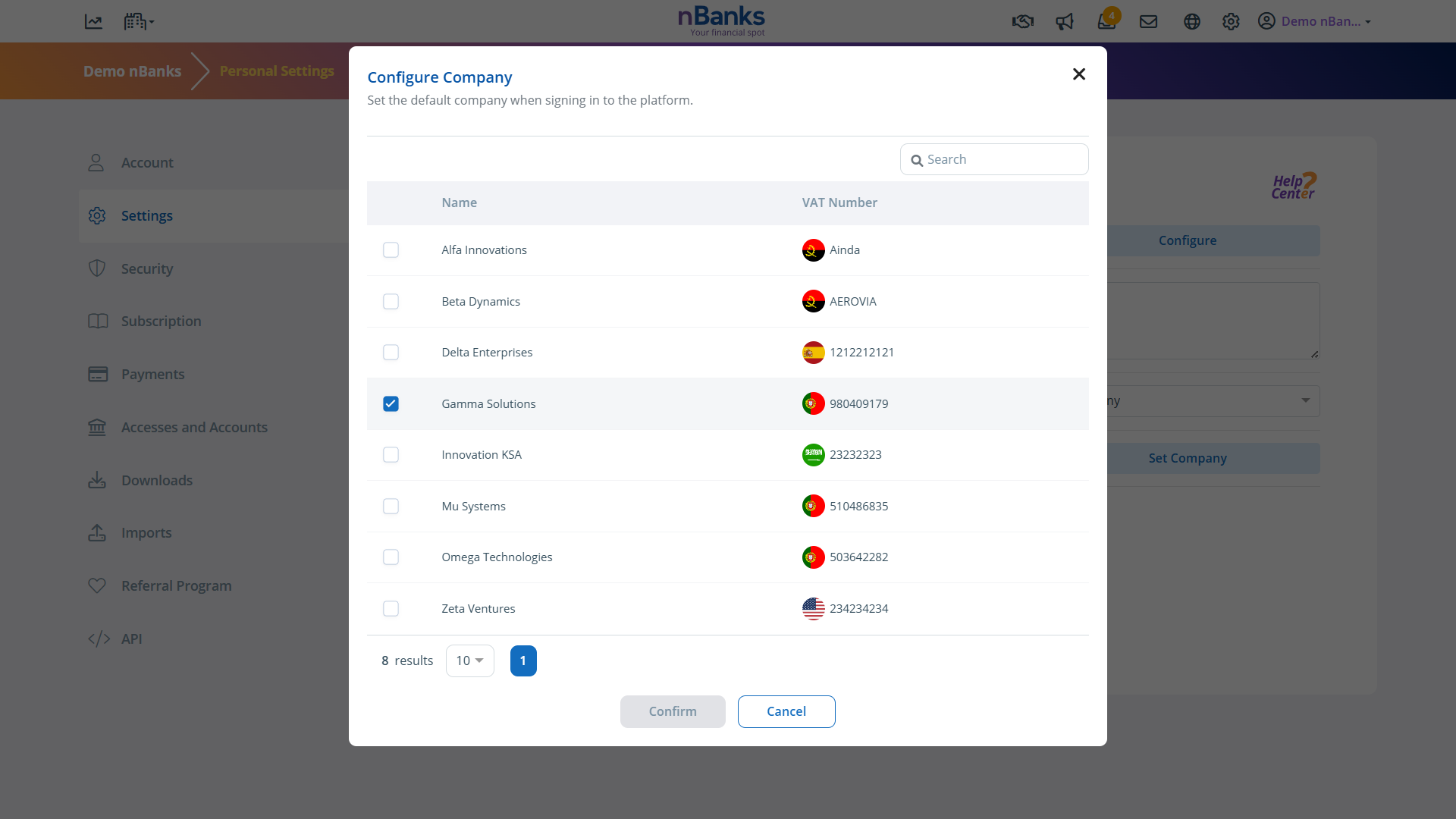
nBanks achieves ISO 27001 certification for Information Security Management. 6 November 2025 Choice of default company presented at login Ability to choose a specific company to be presented on the initial screen. With personalization and navigation efficiency on the platform in mind, nBanks has just released a new update in the General Settings area. With this improvement, users can now define the company that will be selected by default at login, ensuring faster and more practical access to the account they use most frequently. This option saves time in daily operations and simplifies the management process when the user has access to multiple companies within the platform. In the General Settings section, it is possible to choose which company will be defined as “default” when logging in. If the user wants to access another company, they can easily do so through the usual selector. This update reinforces nBanks' commitment to offering an increasingly intuitive, adaptable, and user-centric experience. Benefits: - Faster access to the most used company; - Reduction of clicks and navigation time; - Greater personalization of the login experience; - Ease of managing multiple companies; Available to all platform users. You can try this feature here . Previous Item Next Item
- Welcome to Open Banking | nBanks
nBanks achieves ISO 27001 certification for Information Security Management. 19 June 2019 Welcome to Open Banking Open Banking and Banking Transformation Orlando Costa Open Banking and Banking Transformation The entry into force of the new European Directive “PSD2 (Payment Services Directive)”, which became applicable from January 13, 2018, allowed the processing of customers' bank account data by third parties and not exclusively by banks as before. By inherent nature, it triggered the introduction of a new, broader concept of the European banking market itself: an open and easily accessible ecosystem for all customers and all entities. This concept, designated Open Banking, thus translates into a new model of banking relationship, based on information sharing and transparency, and in which the predisposition for collaboration between financial institutions, fintechs, and other entities is inevitable, as only in this way will they be able to better meet and satisfy the financial needs of their customers. This directive allows for a new, more central and informed positioning of the consumer in this market. Until now, the significant technological development of recent decades has not been accompanied at the same pace in terms of consumer knowledge and behavior, despite the diversity and multiplicity of offerings, as well as the strong investment in technological transformation that the banking sector has made globally. While it is a fact that financial institutions have made a strong commitment to digital transformation to make the “customer journey” in banking services easier and more appealing, it is also true that satisfactory results have not been achieved in simplifying language and understanding products, as well as in their contracting. Thus, as a rule, in the financial market, information inherent to products, services, and their terms and conditions is somewhat complex and quite technical, which does not allow for a quick and direct interpretation of the products presented. Furthermore, with an increasingly diversified offer, consumers in this sector do not have an effective way to compare existing banking products, in light of what they can do in other industries. Although we are still at the beginning and laying the foundations of Open Banking, the principle of this transformation is quite simple, with the financial market becoming increasingly receptive to changes in various dimensions such as innovation, security, and efficiency. With this transformation, everyone benefits: in addition to larger financial institutions, smaller banks, fintechs, and, of course, consumers are included. On the other hand, other big names in the technology industry, such as the so-called “GAFAM – (Google, Amazon, Facebook, Apple, and Microsoft)” may also take advantage of these new measures, if they know how to define the correct strategy. What is Open Banking based on? From January 13, 2018, in the European space, the non-exclusivity in the retention of information related to their customers' accounts by banking institutions was thus defined, and this information can be transferred to third parties, usually called Third Party Providers (TPP), with the due consent of the user/customer. In this way, with this opening of data processing by third parties and these, in turn, with a total focus on providing personalized information services, highly supported by software prepared for mass data processing, it becomes possible to open new channels, the dissemination of “decision making” tools and highly precise statistical processing in favor of banking service users. Although the standardization process of this new banking information communication protocol is still ongoing, it thus becomes natural to access virtual platforms with a wide diversity of banking products, originating from various financial institutions, and by inherent nature to choose the most relevant products for current and future financial needs. What new entities will change the traditional banking relationship? In addition to new fintechs and the transformation that financial institutions will inherently have to implement, two new types of purely technological service providers officially emerged in the financial market, regulated by the European banking authority. Thus, AISP (Account Information Service Provider) and PISP (Payment Initiation Service Provider) become the new acronyms to be known in the European financial ecosystem. Both AISPs and PISPs are entities that were created based on security to provide this type of service exclusively through customer consent. Let's start with AISPs. AISPs, considered companies that manage and provide bank account information, are technological entities that are authorized to collect and store information from each customer's various bank accounts, as well as validate the sharing of this same information with the institutions they choose. Let's move on to PISPs. PISPs, also known as payment initiation service providers, are considered entities that primarily streamline online payments. They thus make a direct connection between the customer's account and the merchant's, being able to consolidate the payment without going through any intermediary. In summary, we now have access to a new model of banking relationship, developed with the customer in mind, with new opportunities arising from this fact. In general, there is a diversification of various roles within the banking and financial market, reinforcing the pillars of data democratization, with mandatory security and confidentiality, as well as the introduction of freedom of choice in a more assertive way, resulting from this new “data library” available to the user. Among various innovations, these new companies can then aggregate information from all their consumers' bank accounts, as well as aggregate information on products from various financial institutions. It therefore seems unquestionable that the simplification of habitually complex banking operational processes will gain its space, which, from the point of view of companies and business professionals, will save immense time, promote efficiency, and reinforce the strategic focus on the “core” activity of each company. Other innovations are appearing and many more will come as a result of this new paradigm. Open Banking, that is, the open, easily accessible banking ecosystem, is here to stay, and there is a strong predisposition for current financial institutions to also be receptive and collaborate strongly with “fintechs” like nBanks and many others to ultimately satisfy the financial needs of their clients. No one knows precisely the “design” of the future banking and financial model that European legislation is generating with the new PSD2 (Payment Service Directive). We know, however, that the paths of transparency, impartiality, and shared information will help pave the right way for this new model. It is now in our hands to make use of the much-needed banking transformation. Previous Item Next Item
- nBanks arrives in Africa with native open banking solutions for businesses | nBanks
nBanks achieves ISO 27001 certification for Information Security Management. 4 November 2022 nBanks arrives in Africa with native open banking solutions for businesses Portuguese fintech becomes a pioneer with native open banking solutions on that continent. nBanks nBanks is the first Portuguese fintech to operate in native Open Banking technology in Africa and will now strengthen its presence on that continent. More than 30 countries will now benefit from the company's financial management service. The goal, by 2025, is to reach at least 50,000 companies and a turnover volume of 35 million euros . Access the news on this topic, which includes CEO Orlando Costa's vision on the potential of this expansion. Previous Item Next Item
- Connect to Other Software via API | nBanks
nBanks achieves ISO 27001 certification for Information Security Management. Connect to Other Software via API Learn how to include information from the nBanks platform in your management software via API. Step 1 Access the Personal Settings area, at the top of the page. Step 2 Select the API tab. Step 3 Choose one of the following options: - Option 1: Request the API key and autonomously develop the integration within your team; - Option 2: Contact the nBanks team for us to develop an integration solution especially for your Management Software. You can find more information about the nBanks API at api.nbanks.net . Previous Item Next Item